Rakesh Kumar Jain, Varsha Kashaw*
SVN Institute of Pharmaceutical Sciences, Swami Vivekananda University Sagar (Madhya Pradesh), India
*Address for Corresponding Author
Dr. (Mrs.) Varsha Kashaw
Prof. & Head
SVN Institute of Pharmaceutical Sciences,
Swami Vivekananda University Sagar, Madhya Pradesh, India
Abstract
Objective: The aim of the present work was to synthesize some new bioactive 1-(4-substituted-phenyl-3-(4-oxo-2-methyl/phenyl-4H-quinazolin-3-yl)-urea and to evaluate them for anticonvulsant activity. Materials and methods: Sixteen compounds were synthesized. Their anticonvulsant activity was evaluated from maximal electroshock-induced seizures and PTZ-induced clonic seizures. MES seizures are considered an animal model of human clonic and/or tonic generalized seizures and PTZ-induced clonic seizures are therefore considered a model of myoclonic/generalized absence epilepsy. Using these basic tests, we can identify and differentiate the anticonvulsant pharmacology of novel compounds. Standard drugs used for both the above studies were phenytoin and carbamazepine respectively. All the test compounds were suspended in 0.5% w/v methyl cellulose. In each of the experiment a control group was made which received the vehicle (0.5% w/v methyl cellulose). Results: Compounds showed significant anticonvulsant activity with low neurotoxicity when compared with the reference drug.Conclusion: Present study explored that substitution of 4(3H)-quinazolinone at second and third position of 4(3H)-quinazolinone leads to the development of new chemical entities with potent sedative-hypnotic as compared to anticonvulsant activity.
Keywords: 4(3H)-Quinazolinone; MES; Subcutaneous pentylenetetrazole induced seizure
Introduction
Epilepsy is a central nervous system (CNS) malfunctionthat leads either to generalized hyperactivity involving essentiallyall parts of the brain or hyperactivity of only a portion ofthe brain (Loscher et al., 1998; Scheuer et al., 1990; Browne et al., 2001). It has been estimated that adequate control ofseizures could not be obtained in up to 20% of the patientswith epilepsy using first generation of antiepileptic drugs (phenobarbital, phenytoin, carbamazepine, sodium valproateand diazepam). A group of new drugs including felbamate, gabapentin,lamotrigine, oxacarbazepine, topiramate, milacemide, vigabatrin and zonisamide is entering into clinicalpractice. The convulsions of approximately 25% of epilepticsare adequately controlled by current clinically available drugs.Current drug therapy is accompanied by numerous side effectsincluding drowsiness, ataxia, gastrointestinal disturbances, gingival hyperplasia, hirsutism and megaloblastic anemia (Brodie et al., 1990; Eadia et al., 1984; Aggarwal et al., 2005). The past decade has witnessed a continuous interest in the development of anticonvulsant drugs.
4(3H)-quinazoline and its derivatives have been reported to exhibit anticonvulsant, antimicrobial, sedative, tranquilizer, analgesic, anesthetic, anticancer, antihypertensive, anti-inflammatory, diuretic and muscle relaxant properties (Armarego, 1979; Fisnerova et al., 1991; Saxena et al., 1991; Gravier et al., 1992; Jatav et al., 2008, 2008a, 2008b, 2008c, 2008d, 2008e, 2010; Kashaw et al., 2008, 2009, 2009a, 2010). 2-Methyl-3-o-tolyl-4(3H)-quinazolinone (Methaqualone) is the most frequently prescribed quinazolinone derivative as a safe sedative-hypnotic and anticonvulsant drug. Literature survey revealed that the presence of substituted aromatic ring at position 3 and methyl/phenyl group at position 2 of 4(3H)-quinazolines are necessary requirement for the central nervous system (CNS) depression and anticonvulsant activity. As mentioned it appears to us that considerable promise for discovering new CNS active agents might be found through the development of new chemistry for the synthesis of structural analogues of those compounds. With the entire mentioned hypothesis as background the present work was carried out with the objectives to observe the alteration in anticonvulsant activity by placing methyl and phenyl group at second position of the nucleus and substituted aromatic ring at position 3 (Fig. 1). This will also help to make out SAR about the steric hindrance. The proposed structure is also inspired from the chemical features of N-desmethyl diazepam and also the proposed target site is benzodiazepine binding site (BDZ), we plan to screen the new compounds for inhibition of locomotors and CNS depressant activity.
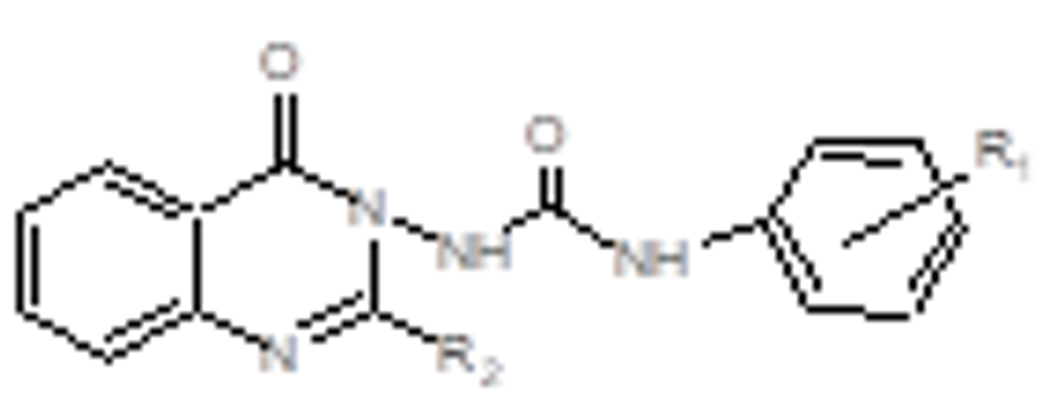
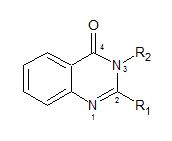 Figure 1. Pictorial depiction of the proposed hypothesis: R1= methyl/phenyl, R2= substituted anilines
Material and Methods
Substituted anilines (4-Cl, 4-F, 4-CH3, 2,5-Cl, 2,4-F, 2,4-CH3, 2,3,4- F, 2,4,6- CH3), Sodium cyanate, hydrazine hydrate, sodium hydroxide, glacial acetic acid, benzoyl chloride, pyridine, substituted benzaldehydes (4-Br, 4-Cl, 4-NO2, 4-CH3) was purchased from CDH (Chemical Drug House), New Delhi, India. The chemical used for experimental work were synthetic grade.The chemical used for experimental work were synthetic grade. The melting points of the synthesized compounds were determined in open glass capillaries. IR spectra were recorded on ALPHA (Bruker) FTIR Spectrometer. Elemental analysis was performed and found values were within 0.4% of theoretical values. 1H NMR and 13C NMR spectra were recorded on BrukerAvance 400 spectrophotometer at 400 MHz, 5 mm multi-nuclear inverse probe head, low and high-temperature facility and HRMAS accessory. Mass Spectra were recorded using Mass Spectrometers Jeol SX-102 (FAB) by ESI.
Chemistry
The synthesis of 1-(4-substituted-phenyl-3-(4-oxo-2-methyl/phenyl-4H-quinazolin-3-yl)-urea is accompanied in Figure 2 and comprises the following steps
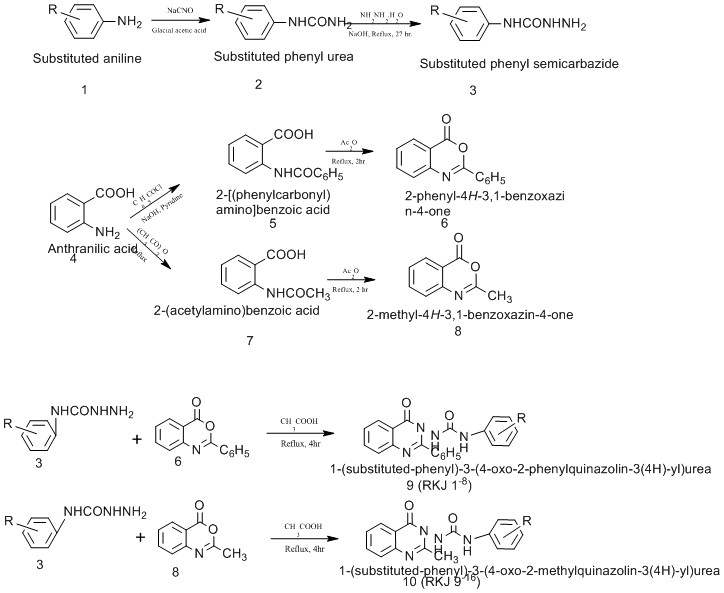 Figure 2. Scheme for synthesis of 1-(4-substituted-phenyl-3-(4-oxo-2-methyl/phenyl-4H-quinazolin-3-yl)-ureaSynthesis of Substituted Phenyl Semicarbazides
Step1: Synthesis of substituted phenyl urea
p-Substituted aniline (0.1 mol) (1) was dissolved in 10-50 ml of glacial acetic acid and volume was made upto 100 ml with water. To this sodium cyanate (0.1 mol) in 50 ml of warm water was added with constant stirring. Solution was allowed to stand for 60 min. then cooled in ice and filtered with suction and dried. The substituted phenyl urea (2) thus obtained was used in the next step without further purification.
Step 2: Synthesis of substituted phenyl semicarbazides
Equimolar quantity of substituted phenyl urea (0.1 mol) (2) and hydrazine hydrate (0.1 mol) in ethanol under alkaline condition (NaOH) were refluxed for 4-10 h with stirring. Excess of ethanol was distilled off under vacuum and then poured into ice. The obtained product was filtered and recrystallized from 90% aqueous ethanol. Generally compounds exhibited IR (KBr) νmax 3450, 1650, 3269, 844 cm-1. 1H NMR δ 7.2-7.5 (m, 4H, Ar-H), 8.26 (s, 1H, Ar-NH).
Synthesis of 2-Substituted benzoxazin-4-one
Anthranilic acid, 4 (0.1 mol) was refluxed with benzoylchloride/ acetic anhydride for 2 h. Excess of anhydride was distilled off by vacuum distillation to obtain the precipitate of N-phenyl anthranilic acid (5)/N-acetyl anthranilic acid (7) which was further refluxed with acetic anhydride for 2 h to get 2-phenyl benzoxazin-4-one (6) / 2-methyl benzoxazin-4-one (8).
Synthesis of title compound
Synthesis of Quinazolinones
The title compounds were synthesized following procedure reported earlier. To a solution of 2-phenyl benzoxazin-4-one/2-methyl benzoxazin-4-one (6/8) (0.01 M), substituted phenyl semicarbazides (0.01M) in glacial acetic acid was added and refluxed for 4 h. Obtained reaction mixture was poured into crushed ice and left overnight. The solid which separated out was filtered, washed with cold distilled water, dried and recrystallized from hot ethanol.
Characterization
Melting points were determined in one end open capillary tubes on a Buchi 530 melting point apparatus and are uncorrected. Infrared (IR) and 13C nuclear magnetic resonance (13C NMR) spectra were recorded for the compounds on PerkinElmer Spectrum RXI Spectrophotometer in KBr pelletsand13C Advance Bruker (300 MHz) instrument, respectively.Chemical shifts are reported in parts per million (ppm) usingtetramethylsilane (TMS) as an internal standard. Elementalanalysis (C, N and S) was undertaken with Elemental VarioEL III Carlo Erba 1108 analyzer. The purity of the compoundswas confirmed by thin layer chromatography using silica gelglass plates and a solvent system of benzene:ethanol (8:2).The spots were developed in iodine chamber and visualizedunder ultraviolet lamp. List of all synthesized compounds was tabulated in Table. 1. Physical properties of the synthesized title compounds shown in table 2.
Table 1. List of synthesized compounds
|
Code |
Chemical name |
|
|
|
R2 |
R1 |
||
|
RKJ1 |
1-(4-chlorophenyl)-3-(4-oxo-2-phenylquinazolin-3(4H)-yl)urea |
-C6H5 |
-Cl |
|
RKJ2 |
1-(4-fluorophenyl)-3-(4-oxo-2-phenylquinazolin-3(4H)-yl)urea |
-C6H5 |
-F |
|
RKJ3 |
1-(4-methylphenyl)-3-(4-oxo-2-phenylquinazolin-3(4H)-yl)urea |
-C6H5 |
p-CH3 |
|
RKJ4 |
1-(2,5-dichlorophenyl)-3-(4-oxo-2-phenylquinazolin-3(4H)-yl)urea |
-C6H5 |
2,5-Cl |
|
RKJ5 |
1-(2,4-difluorophenyl)-3-(4-oxo-2-phenylquinazolin-3(4H)-yl)urea |
-C6H5 |
2,4-F |
|
RKJ6 |
1-(2,4-dimethylphenyl)-3-(4-oxo-2-phenylquinazolin-3(4H)-yl)urea |
-C6H5 |
2,4-CH3 |
|
RKJ7 |
1-(2,3,4-trifluorophenyl)-3-(4-oxo-2-phenylquinazolin-3(4H)-yl)urea |
-C6H5 |
2,3,4- F |
|
RKJ8 |
1-(2,4,6-trimethylphenyl)-3-(4-oxo-2-phenylquinazolin-3(4H)-yl)urea |
-C6H5 |
2,4,6- CH3 |
|
RKJ9 |
1-(4-chlorophenyl)-3-(2-methyl-4-oxoquinazolin-3(4H)-yl)urea |
-Me |
-Cl |
|
RKJ10 |
1-(4-fluorophenyl)-3-(2-methyl-4-oxoquinazolin-3(4H)-yl)urea |
-Me |
-F |
|
RKJ11 |
1-(4-methylphenyl)-3-(2-methyl-4-oxoquinazolin-3(4H)-yl)urea |
-Me |
p-CH3 |
|
RKJ12 |
1-(2,5-dichlorophenyl)-3-(2-methyl-4-oxoquinazolin-3(4H)-yl)urea |
-Me |
2,5-Cl |
|
RKJ13 |
1-(2,4-difluorophenyl)-3-(2-methyl-4-oxoquinazolin-3(4H)-yl)urea |
-Me |
2,4-F |
|
RKJ14 |
1-(2,4-dimethylphenyl)-3-(2-methyl-4-oxoquinazolin-3(4H)-yl)urea |
-Me |
2,4-CH3 |
|
RKJ15 |
1-(2,3,4-trifluorolphenyl)-3-(2-methyl-4-oxoquinazolin-3(4H)-yl)urea |
-Me |
2,3,4- F |
|
RKJ16 |
1-(2,4,6-trimethylphenyl)-3-(2-methyl-4-oxoquinazolin-3(4H)-yl)urea |
-Me |
2,4,6- CH3 |
Table 2. Physical properties of the synthesized title compounds
|
Compound Code |
Mol. Formula |
Mol. Wt. |
Elemental analysis % found (calculated) |
|
RKJ1 |
C21H15ClN4O2 |
390.82 |
C, 64.54; H, 3.87; N, 14.34 |
|
RKJ2 |
C21H15FN4O2 |
374.37 |
C, 67.37; H, 4.04; N, 14.97 |
|
RKJ3 |
C22H18N4O2 |
370.4 |
C, 71.34; H, 4.90; N, 15.13 |
|
RKJ4 |
C15H9Cl2N4O2 |
348.16 |
C, 51.75; H, 2.61N, 16.09 |
|
RKJ5 |
C21H14F2N4O2 |
392.36 |
C, 64.28; H, 3.60; N, 14.28 |
|
RKJ6 |
C23H20N4O2 |
384.43 |
C, 71.86; H, 5.24; N, 14.57 |
|
RKJ7 |
C21H13F3N4O2 |
410.1 |
C, 61.47; H, 3.19; N, 13.65 |
|
RKJ8 |
C24H22N4O2 |
398.46 |
C, 72.34; H, 5.57; N, 14.06 |
|
RKJ9 |
C16H13ClN4O2 |
328.75 |
C, 58.45; H, 3.99; N, 17.04 |
|
RKJ10 |
C16H13FN4O2 |
312.3 |
C, 61.53; H, 4.20; N, 17.94 |
|
RKJ11 |
C17H16N4O2 |
308.33 |
C, 66.22; H, 5.23; N, 18.17 |
|
RKJ12 |
C16H12Cl2N4O2 |
363.2 |
C, 52.91; H, 3.33; N, 15.43 |
|
RKJ13 |
C16H12F2N4O2 |
330.29 |
C, 58.18; H, 3.66; N, 16.96 |
|
RKJ14 |
C18H18N4O2 |
322.36 |
C, 67.07; H, 5.63; N, 17.38 |
|
RKJ15 |
C16H11F3N4O2 |
348.28 |
C, 55.18; H, 3.18; N, 16.09 |
|
RKJ16 |
C19H20N4O2 |
336.39 |
C, 67.84; H, 5.99; N, 16.66 |
RKJ1:1-(4-chlorophenyl)-3-(4-oxo-2-phenylquinazolin-3(4H)-yl)urea
Molecular Formula: C21H15ClN4O2; Molecular weight: 390.82; 13C NMR (DMSO-d6, d ppm): 153.8 C12 of phenyl urea, 129.0 C24 and C26 of phenyl ring, 120.8 C23 and C27 of phenyl ring and C3 of 4(3H)-quinazolinone ring, 137.5 C22 of the phenyl ring, 160.6 C2 of 4(3H)-quinazolinone ring, 148.7 C 4 of 4(3H)-quinazolinone ring, 156.2 C6 of 4(3H)-quinazolinone ring, 126.6 C7 and C10 of 4(3H)-quinazolinone ring, 127.3 C8 of 4(3H)-quinazolinone ring, 133.4 C9 of 4(3H)-quinazolinone ring and C25 of the phenyl ring, 128.6 C15 of the phenyl ring at C-6 of 4(3H)-quinazolinone ring, 128.2 C16 and C20 of the phenyl ring at C-6 of 4(3H)-quinazolinone ring, 128.8 C17 and C19 of the phenyl ring at C-6 of 4(3H)-quinazolinone ring, 130.1 C18 of the phenyl ring at C-6 of 4(3H)-quinazolinone ring; IR (cm-1, KBr): 3110 C-H str aromatic ring, 1670 C=O str carbonyl group (quinazolinone ring), 1578 C=C str aromatic ring, 1657C=O str Phenyl urea, 1225 C-N str quinazolinone ring, 1570 C=N str quinazolinone ring, 3333 N-H str Phenyl urea, 1090 C-Clstr (Aryl C-Cl ) ; Mass (m/z): 389.
RKJ2: 1-(4-fluorophenyl)-3-(4-oxo-2-phenylquinazolin-3(4H)-yl)urea
Molecular Formula: C21H15FN4O2; Molecular weight: 374.37; 13C NMR (DMSO-d6, d ppm): 115.7 C24 and C26 of phenyl ring, 129.3 C23 and C27 of phenyl ring, 135 C22 of the phenyl ring, 62.9 C25 of the phenyl ring ; IR (cm-1, KBr): 1190 C-F str (Aryl C-F); Mass (m/z): 372
RKJ3: 1-(4-methylphenyl)-3-(4-oxo-2-phenylquinazolin-3(4H)-yl)urea
Molecular Formula: C22H18N4O2; Molecular weight: 370.4; 13C NMR (DMSO-d6, d ppm): 129.2 C24 and C26 of phenyl ring, 121.5 C23 and C27 of phenyl ring, 136.4 C22 of the phenyl ring, 136.8 C25 of the phenyl ring, 21.3 C28 of the phenyl ring; IR (cm-1, KBr): 2950 C-H str (Alkyl group) ; Mass (m/z): 371.
RKJ4: 1-(2,5-dichlorophenyl)-3-(4-oxo-2-phenylquinazolin-3(4H)-yl)urea
Molecular Formula: C15H9Cl2N4O2; Molecular weight: 348.16; 13C NMR (DMSO-d6, d ppm): 132.8, 128.9, 130.6, 131.3, 121, 127.9 of C22-C27 of the phenyl ring; IR (cm-1, KBr):1100 C-Clstr Aryl C-Cl, bending vibrations (wag) of the C-H bonds of the aromatic ring: 790 and 880; Mass (m/z): 347.01.
RKJ5: 1-(2,4-difluorophenyl)-3-(4-oxo-2-phenylquinazolin-3(4H)-yl)urea
Molecular Formula: C21H14F2N4O2; Molecular weight: 392.36; 13C NMR (DMSO-d6, d ppm): 114.7, 164.4, 104.9, 160.7, 111.3, 124.8 of C22-C27 of the phenyl ring; IR (cm-1, KBr):1180 C-F str (Aryl C-F), C-H (Wag) 760 and 900; Mass (m/z): 392.11
RKJ6: 1-(2,4-dimethylphenyl)-3-(4-oxo-2-phenylquinazolin-3(4H)-yl)urea
Molecular Formula: C23H20N4O2; Molecular weight: 384.43; 13C NMR (DMSO-d6, d ppm): 131.7, 134.2, 131.1, 143.4, 126.2, 114.7 of C22-C27 of the phenyl ring and 17.6, 21.6 of methyl at C23, C25; IR (cm-1, KBr): 2910 C-H str (Alkyl group) C-H (Wag) 770 and 900 ; Mass (m/z): 384.16
RKJ7: 1-(2,3,4-trifluorophenyl)-3-(4-oxo-2-phenylquinazolin-3(4H)-yl)urea
Molecular Formula: C21H13F3N4O2; Molecular weight: 410.1; 13C NMR (DMSO-d6, d ppm): 116.3, 153.9, 137.2, 146.7, 110.4, 120.4 of C22-C27 of the phenyl ring; IR (cm-1, KBr): 1190 C-F str (Aryl C-F) C-H (Wag) 770; Mass (m/z): 410.10
RKJ8: 1-(2,4,6-trimethylphenyl)-3-(4-oxo-2-phenylquinazolin-3(4H)-yl)urea
Molecular Formula: C24H22N4O2; Molecular weight: 398.46; 13C NMR (DMSO-d6, d ppm):131.5, 134.1, 128.1, 136.4, 128.1, 134.1 of C22-C27 of the phenyl ring and 17.9 of methyl at C23 and C27, 21.9 of methyl at C26 ; IR (cm-1, KBr): 2910 C-H str (Alkyl group), C-H (Wag) 770 ; Mass (m/z): 398.1.
RKJ9: 1-(4-chlorophenyl)-3-(2-methyl-4-oxoquinazolin-3(4H)-yl)urea
Molecular Formula: C16H13ClN4O2; Molecular weight: 328.75; 13C NMR (DMSO-d6, d ppm): 153.8 C12 of phenyl urea, 129.0 C19 and C21 of phenyl ring, 120.8 C18 and C22 of phenyl ring and C3 of 4(3H)-quinazolinone ring, 137.5 C17 of the phenyl ring, 160.6 C2 of 4(3H)-quinazolinone ring, 146.9 C 4 of 4(3H)-quinazolinone ring, 156.4 C6 of 4(3H)-quinazolinone ring, 126.6 C7 and C10 of 4(3H)-quinazolinone ring, 127.3 C8 of 4(3H)-quinazolinone ring, 133.4 C9 of 4(3H)-quinazolinone ring and C25 of the phenyl ring, 19.5 C15 of the phenyl ring at C-6 of 4(3H)-quinazolinone ring; IR (cm-1, KBr):3110 C-H str (aromatic ring), 1670 C=O str carbonyl group (quinazolinone ring), 1578 C=C str (aromatic ring), 1657 C=O str (Phenyl urea), 1225 C-N str (quinazolinone ring), 1570 C=N str quinazolinone ring), 3333 N-H str (Phenyl urea), 1090 C-Clstr (Aryl C-Cl); Mass (m/z): 328.0
RKJ10: 1-(4-fluorophenyl)-3-(2-methyl-4-oxoquinazolin-3(4H)-yl)urea
Molecular Formula: C16H13FN4O2; Molecular weight: 312.3; 13C NMR (DMSO-d6, d ppm): 115.7 C19 and C21 of phenyl ring, 119.3 C18 and C22 of phenyl ring, 135 C17 of the phenyl ring; IR (cm-1, KBr): 1180 C-F str (Aryl C-F); Mass (m/z): 312.1
RKJ11: 1-(4-methylphenyl)-3-(2-methyl-4-oxoquinazolin-3(4H)-yl)urea
Molecular Formula: C17H16N4O2; Molecular weight: 308.33; 13C NMR (DMSO-d6, d ppm): 129.2 C19 and C21 of phenyl ring, 121.5 C18 and C22 of phenyl ring, 136.4 C17 of the phenyl ring; IR (cm-1, KBr): 2950 C-H str (Alkyl group); Mass (m/z): 308.1
RKJ12: 1-(2,5-dichlorophenyl)-3-(2-methyl-4-oxoquinazolin-3(4H)-yl)urea
Molecular Formula: C16H12Cl2N4O2; Molecular weight: 363.2; 13C NMR (DMSO-d6, d ppm): 128.2 C19 and C21 of phenyl ring, 133.3 C18 and C22 of phenyl ring, 129.4 C17 of the phenyl ring; IR (cm-1, KBr): 1080 C-Clstr (Aryl C-Cl), bending vibrations (wag) of the C-H bonds of the aromatic ring: 780 and 870 ; Mass (m/z): 362
RKJ13: 1-(2,4-difluorophenyl)-3-(2-methyl-4-oxoquinazolin-3(4H)-yl)urea
Molecular Formula: C16H12F2N4O2; Molecular weight: 330.29; 13C NMR (DMSO-d6, d ppm): 114.7, 164.4, 104.9, 160.3, 111.3, 124.8 of C17-C22 of the phenyl ring ; IR (cm-1, KBr):1170 C-F str Aryl C-F, C-H (wag) 760 and 910; Mass (m/z): 330.09
RKJ14: 1-(2,4-dimethylphenyl)-3-(2-methyl-4-oxoquinazolin-3(4H)-yl)urea
Molecular Formula: C18H18N4O2; Molecular weight: 322.36; 13C NMR (DMSO-d6, d ppm):131.7, 134.2, 131.1, 143.4, 126.2, 114.7 of C17-C22 of the phenyl ring and 21.6 for terminal C-H3; IR (cm-1, KBr): 2900 C-H str (Alkyl group), C-H (wag) 770 and 910 ; Mass (m/z): 322.14
RKJ15: 1-(2,3,4-trifluorolphenyl)-3-(2-methyl-4-oxoquinazolin-3(4H)-yl)urea
Molecular Formula: C16H11F3N4O2; Molecular weight: 348.28; 13C NMR (DMSO-d6, d ppm): 116.3, 153.9, 137.2, 146.7, 110.4, 120.4 of C17-C22 of the phenyl ring; IR (cm-1, KBr): 1190 C-F str Aryl C-F, C-H (wag)760 ; Mass (m/z): 348.08
RKJ16: 1-(2,4,6-trimethylphenyl)-3-(2-methyl-4-oxoquinazolin-3(4H)-yl)urea
Molecular Formula: C19H20N4O2; Molecular weight: 336.39; 13C NMR (DMSO-d6, d ppm): 131.5, 124.1, 128.1, 136.4, 128.1, 134.1 of C17-C22 of the phenyl ring and 17.9 of methyl at C18 and C22, 21.9 of methyl at C20; IR (cm-1, KBr): 2920 C-H str (Alkyl group), C-H (wag)780; Mass (m/z): 336.16
Evaluation of pharmacological activity
Animals
Albino mice of either sex (20-30 g) were used as experimental animals for anticonvulsant. Animals were kept in wire-mesh cages in a restricted-access room for one week before the experiments. Twelve days wash period was allowed prior to start of next study. The animals were fed with standard lab pellets and purified water ad libitum. Prior to the experiments animals were fasted for 12 h. All the test compounds were suspended in 0.5% w/v methyl cellulose. In each of the experiment a control group was made which received the vehicle
(0.5% w/v methyl cellulose).All the experiments were carried out according to protocols approved by the Institutional Animal Ethical Committee, Sagar Institute of Pharmaceutical Sciences, Sagar (Committee registration number 1387/a/10/CPCSEA and Letter reference number is Animal ethical committee SIPS/EC/2015/68 dated 17-10-16).
Pharmacological evaluation of Synthesized compounds
Anticonvulsant evaluation of 1-(4-substituted-phenyl-3-(4-oxo-2-methyl/phenyl-4H-quinazolin-3-yl)-urea was done by the anticonvulsant drugdevelopment (ADD) program protocol (Krall et al., 1978; Pester et al., 1984). The profileof anticonvulsant activity was established after i.p. injectionby the MES pattern test and the subcutaneous pentylenetetrazole (scPTZ) seizure threshold test. Minimal motor impairmentwas measured by the rotorod (neurotoxicity, NT) test using doses of 30, 100 and 300 mg/kg at two different timeintervals. Same compounds were studied for their CNS behavioralactivity in mice using actophotometer.
Anticonvulsant screening
Initially all the compounds were administered i.p. in a volume of 0.01 ml/g body weight for mice at doses of 30, 100, 300 mg/kg to one to four animals. Activity was established using the MES and scPTZ tests and these data are presented in table 3.
Neurotoxicity screening
Minimal motor impairment was measured in mice by the rotorod test. The mice were trained to stay on an accelerating rotorod that rotates at six revolutions per minute. The rod diameter was 3.2 cm. Neurotoxicity was indicated by the inability of the animal to maintain equilibrium on the rod for at least 1 min in each of the three trials. The data was presented in table 3.
Table 3. Anticonvulsant activity and minimal motor impairment of 1-(4-substituted-phenyl-3-(4-oxo-2-methyl/phenyl-4H-quinazolin-3-yl)-urea
|
Compounds |
Intraperitoneal injection in micea |
|||||
|
MES screen |
scPTZ screen |
Neurotoxicity screen |
||||
|
0.5 h |
4 h |
0.5 h |
4 h |
0.5 h |
4 h |
|
|
RKJ1 |
30 |
- |
- |
- |
- |
- |
|
RKJ2 |
- |
- |
- |
- |
- |
- |
|
RKJ3 |
- |
- |
- |
- |
- |
- |
|
RKJ4 |
100 |
100 |
300 |
300b |
- |
- |
|
RKJ5 |
- |
100 |
- |
- |
100 |
- |
|
RKJ6 |
- |
- |
- |
- |
300 |
- |
|
RKJ7 |
- |
- |
- |
- |
100c |
- |
|
RKJ8 |
- |
- |
- |
- |
300 |
- |
|
RKJ9 |
- |
- |
300 |
- |
- |
- |
|
RKJ10 |
- |
300 |
300 |
300c |
- |
- |
|
RKJ11 |
- |
300 |
- |
- |
- |
- |
|
RKJ12 |
- |
- |
- |
- |
- |
- |
|
RKJ13 |
- |
- |
- |
- |
- |
- |
|
RKJ14 |
- |
- |
- |
- |
- |
- |
|
RKJ15 |
- |
- |
- |
- |
- |
-- |
|
RKJ16 |
- |
300 |
- |
- |
- |
- |
|
Phenytoind |
30 |
30 |
- |
- |
100 |
100 |
|
Carbamazepined |
30 |
100 |
100 |
300 |
100 |
300 |
aDoses of 30, 100 and 300 mg/kg were administered. The values in the tableindicate the minimum dose whereby bioactivity was demonstrated in half or more of the mice. The animals were examined 0.5 and 4 h after the injections were made; the symbol (-) indicates the absence of activity at maximum dose administered (300 mg/kg).
bDied during test at 300 mg/kg without seizure; cLoss of righting reflux; eAt 100 mg/kg after 0.25 h, 3/5 and after 1 h 4/5 mice were protected; dData from Refs. (Jain et al., 2000; Jatav et al., 2006; Aggarwal et al., 2004)
Behavioral testing
The title compounds (100 mg/kg) were screened for their behavioral effect using actophotometer(Boisser et al., 1965) at 30 min and1 h after drug administration. The behavior of animals inside the photocell was recorded as a digital score. Increased scores suggest good behavioral activity. Percentage decrease in locomotor activity is calculated with the help of activity score of control (24 h prior) and score after 1 h of drug treatment. Mean values were taken for the calculations. The control group animal was administered with PEG 400. The observations are tabulated in table 4.
Results and discussion
The structures of the synthesized compounds (RKJ1-RKJ16) were characterized by IR, 1H NMR spectra, 13C NMR spectra, Mass Spectroscopy and elemental method of analysis. These synthesized compounds were screened for anticonvulsant activity. Anticonvulsant activity was evaluated by maximal electroshock (MES), subcutaneous pentylenetetrazole (scPTZ), neurotoxicity screens and CNS behavioral activity in mice using rotorod test and actophotometer respectively. Initial anticonvulsant activity and neurotoxicity data for the quinazolinone analogs are reported in Table 3, along with the literature data on phenytoin, carbamazepine(Flaherty et al., 1996; Dimmock et al., 1996). In this series all the quinazolinone analogs showed more potent sedative hypnotic than anticonvulsant activity. In the earlier reports it was highlighted that the presence of electron rich atom/group attached at the para position of the aryl ring showed increased potency in the MES screen. Compounds RKJ (1, 4, 5, 9, 10, 11) and RKJ16 were found to exhibit anticonvulsant activity in MES screen, however, compound RKJ1 showed potency similar to standard drug (phenytoin, carbamazepine) without any neurotoxicity. All the synthesized compounds were active in MES screen for a long duration of time (after 4 h). Compound RKJ4 displayed activity in the MES screen after 0.5 h (100 mg/kg) and 4 h (100 mg/kg) while it was active at both 0.5 h (300 mg/kg) and 4 h (300 mg/kg) in the scPTZ test. This compound exhibited rapid onset of action and long duration of activity. Compounds RKJ (2, 3, 6, 7, 8, 12, 13, 14) and RKJ15 did not show any activity in MES as well as in scPTZ after 0.5 h. Compounds RKJ (5, 6, 7) and RKJ8 showed neurotoxicity after 0.5 h at 300 mg/kg body weight. The most active compound in the scPTZ test, a test used to identify compound that elevates seizure threshold, were RKJ10. All the compounds were screened for behavior study and CNS depressant activity. In the behavioral study using actophotometer scoring technique, compounds showed decrease in locomotor activity between 36% and 71% where 36% was the lowest and 71% was the maximal decrease in locomotor activity when compared to phenytoin as Reported in table 4.
Table 4. Behavioral study of 1-(4-substituted-phenyl-3-(4-oxo-2-methyl/phenyl-4H-quinazolin-3-yl)-urea
|
Compounds |
Activity score |
% Inhibition |
||
|
Control |
Post treatment |
|||
|
0.5 h After |
1 h After |
|||
|
RKJ1 |
559.32 ± 20.78 |
472.31 ± 26.78 |
249.45 ± 11.69 |
55 |
|
RKJ2 |
416.04 ± 11.26 |
381.82 ± 9.69 |
266.36 ± 11.89 |
36 |
|
RKJ3 |
442.24 ± 10.42 |
531.00 ± 17.22NS |
467.00 ± 21.11NS |
- |
|
RKJ4 |
418.10 ± 9.97 |
250.62 ± 10.30 |
132.04 ± 12.16 |
68 |
|
RKJ5 |
454.16 ± 10.62 |
319.57 ± 9.66 |
165.52 ± 12.70 |
63 |
|
RKJ6 |
454.72 ± 20.52 |
372.87 ± 2.21 |
489.92 ± 11.63NS |
- |
|
RKJ7 |
467.63 ± 8.89 |
419.24 ± 6.12 |
210.24 ± 12.62 |
55 |
|
RKJ8 |
442.82 ± 21.24 |
308.13 ± 7.25 |
180.30 ± 12.05 |
59 |
|
RKJ9 |
398.46 ± 26.18 |
315.46 ± 4.56 |
142.19 ± 13.28 |
64 |
|
RKJ10 |
410.52 ± 10.62 |
306.98 ± 21.13 |
155.31 ± 17.30 |
62 |
|
RKJ11 |
324.76 ± 27.73 |
292.39 ± 29.87 |
110.45 ± 11.25 |
66 |
|
RKJ12 |
468.62 ± 13.38 |
362.37 ± 11.02 |
228.32 ± 26.72 |
51 |
|
RKJ13 |
420.86 ± 30.22 |
353.52 ± 6.77 |
185.15 ± 31.79 |
55 |
|
RKJ14 |
397.92 ± 10.80 |
272.19 ± 2.11 |
137.19 ± 32.84 |
65 |
|
RKJ15 |
328.16 ± 32.96 |
291.39 ± 1.02 |
92.20 ± 34.91 |
71 |
|
RKJ16 |
435.72 ± 22.66 |
373.56 ± 2.35 |
153.08 ± 10.90 |
64 |
|
Phenytoin |
546.40 ± 31.12 |
251.02 ± 12.32 |
164.10 ± 30.11 |
70 |
The compounds were tested at a dose of 100 mg/kg i.p.
Each score represents the means ± SEM of six mice significantly different from the control score at p < 0.05 and NS at p > 0.05 denotes not significant (Student’s t-test).
Conclusion
This study concluded that these synthesized compounds have potential anticonvulsant activity and other pharmacological activity also prompted. Generally compounds possessing higher log p value showed higher decrease in locomotor activity. Bulkier compounds are more lipophilic and can cross blood-brain barrier to exert their effect on CNS. Present study explored that substitution of 4(3H)-quinazolinone at second and third position of 4(3H)-quinazolinone leads to the development of new chemical entities with potent sedative-hypnotic as compared to anticonvulsant activity.
Acknowledgement
Firstly I am thankful to Dr. Sushil Kumar Kashaw for precious guidance during this work.I would like to thank SAIF, Punjab University, Chandigarh for carried out the IR, 13C NMR, Mass spectroscopy for characterization of synthesized compounds.
Conflicts of interest
The author declares no conflicts of interest.
References
Aggarwal N, Mishra P. 2005. Synthesis and evaluation of 4-substituted semicarbazones of levulinic acid for anticonvulsant activity. J Zhejiang Univ Sci B, 6(7): 617-21. PMC1389793.
Armarego WLF. 1979. In Advance Heterocyclic Chemistry; Katritzky, AR. 1-62.
Boisser JR, Simon P. 1965. Amoxapine in experimental psychopharmacology: a neuroleptic or an antidepressant. Archives Internationales de Pharmacodynamie, 158:21.
Brodie MJ. 1990. Established anticonvulsants and treatment of refractory epilepsy. The Lancet, 336(8711):350-4.
Fišnerová L, Brunová B, Kocfeldová Z, Tíkalová J, Maturová E, Grimová J. 1991. Synthesis and analgetic efficiency of some oxy and oxo derivatives of 4(3H)-quinazolinone. Collection of Czechoslovak Chemical Communications, 56(11):2373-81.
Gravier D, Dupin JP, Casadebaig F, Hou G, Boisseau M, Bernard H. 1992. Synthesis and in-vitro study of platelet antiaggregant activity of some 4-quinazolinone derivatives. Die Pharmazie, 47(2):91-4.
Gupta A, Mishra P, Kashaw SK, Jatav V. 2008. Synthesis, anticonvulsant, antimicrobial and analgesic activity of novel 1,2,4-dithiazoles. Indian Journal of Pharmaceutical Sciences, 70(4):535.
Gupta V, Kashaw SK, Jatav V, Mishra P. 2008. Synthesis and antimicrobial activity of some new 3-[5-(4-substituted)-phenyl-1, 3, 4-oxadiazole-2yl]-2-styrylquinazoline-4 (3H)-ones. Medicinal Chemistry Research, 17(2-7):205-11.
Jain SK, Mishra P. 2000. Synthesis of some 2-amino-5-Aryl-1, 3, 4-thiadiazoles. Asian Journal of Chemistry, 12(4):1341.
Jatav V, Jain SK, Kashaw SK, Mishra P. 2006. Synthesis and anti-microbial activity of novel 2-Methyl-3-(1'3'4'-Thiadiazoyl)-4-(3h) Quinazolinones. Indian Journal of Pharmaceutical Sciences, 68(3):360-363.
Jatav V, Kashaw S, Mishra P. 2008. Synthesis, antibacterial and antifungal activity of some novel 3-[5-(4-substituted phenyl) 1, 3, 4-thiadiazole-2-yl]-2-styryl quinazoline-4 (3H)-ones. Medicinal Chemistry Research. 17(2-7):169-81.
Jatav V, Mishra P, Kashaw S, Stables JP. 2008 Synthesis and CNS depressant activity of some novel 3-[5-substituted 1, 3, 4-thiadiazole-2-yl]-2-styryl quinazoline-4 (3H)-ones. European Journal of medicinal chemistry, 43(1):135-41.
Jatav V, Mishra P, Kashaw S, Stables JP. 2008. CNS depressant and anticonvulsant activities of some novel 3-[5-substituted 1, 3, 4-thiadiazole-2-yl]-2-styryl quinazoline-4 (3H)-ones. European Journal of Medicinal Chemistry, 43(9):1945-54.
Kashaw SK, Gupta V, Kashaw V, P. Mishra, Stables JP, N.K. Jain. 2010. Medicinal Chemistry Research, 19: 250-261.
Kashaw SK, Kashaw V, Mishra P, Jain NK, Stables JP. 2009. Synthesis, anticonvulsant and CNS depressant activity of some new bioactive 1-(4-substituted-phenyl)-3-(4-oxo-2-phenyl/ethyl-4H-quinazolin-3-yl)-urea. European Journal of Medicinal Chemistry, 44(11):4335-43.
Kashaw SK, Kashaw V, Mishra P, Jain NK, Stables JP. 2011. Design, synthesis, and potential CNS activity of some new bioactive 1-(4-substituted-phenyl)-3-(4-oxo-2-methyl-4H-quinazolin-3-yl)-urea. Medicinal Chemistry Research., 20(6):738-45.
Kashaw SK, Kashaw V, Mishra P, Jain NK. 2008. Design, synthesis and potential CNS activity of some novel 1-(4-substituted-phenyl)-3-(4-oxo-2-propyl-4H-quinazolin-3-yl)-urea. Arkivoc. 14:17-26.
Kumar A, Kashaw V, Irchhiaya R, Kashaw SK, Shukla SK. 2010. Synthesis and biological screening of some novel 2-amino-5-aryl-1,3,4-oxadiazole analogues. Medicinal Chemistry Research, 19:S46-S46.
Mishra P, Jatav V, Kashaw SK. 2007. Some Novel 2‐Methyl‐3‐(1′,3′,4′‐thiadiazoyl)‐4‐(3H) quinazolinone with Anticonvulsant and CNS Depressant Activity. Chem Inform, 21;38(34)
Navneet A, Pradeep M. 2005. Synthesis and evaluation of 4-substituted semicarbazones of levulinic acid for anticonvulsant activity. Journal of Zhejiang University Science B. 1;6(7):617-21.
Pester RJ, Cereghino JJ, Gladding GD, Hessie BJ, Kupferberg HJ, Seoville B, White B. Antiepileptic Drug Development Program. Cleve. Clin. Q. 51 (1984) 293-305.
Porsolt RD, Anton G, Blanet N, Jalfre M. 1978. Behavioral despair in rats: a new model sensitive to antidepressants treatment. European Journal of Pharmacology, 47: 379-391.
Saxena S, Verma M, Saxena AK, Shanker K. 1991. Anti-inflammatory quinazolinone. Indian Journal of Pharmaceutical Sciences, 53:48-52.
Scheuer ML, Pedley TA. 1990. The evaluation and treatment of seizures. New England Journal of Medicine, 323(21):1468-74.