Dr. Richa Dayaramani
Tolani Institute of Pharmacy, Adipur, Kachchh, Gujarat, India
Abstract
Objective: Anaemia is characterized by low levels of haemoglobin in blood. It is a common nutritional disorder is the most common cause of malnutrition. It has important public health significance affecting children, adolescents and women of reproductive age world-wide. The magnitude of anaemia is not well document in Adipur – Gandhidham - Anjar complex till date. Hence this prevalence study was taken up with an objective to estimate the magnitude of anaemia in women of reproductive age. Methods: A cross sectional study was conducted, Hb was estimated using automated multi analyser and the data was analyzed statistically. Results and conclusion: The prevalence rate was determined and it was concluded that there is existence of anaemia at an alarming extent (around 75%) within the women of this area and need for iron supplementation and further investigations is underlined.
Keywords: Anaemia, women, iron deficiency, reproductive age
Introduction
Red blood cells carry oxygen to all cells in our body. Haemoglobin (Hb) is a protein found in red blood cells that binds to oxygen molecules and delivers oxygen to tissues and cells via our circulatory system. When haemoglobin levels fall below normal levels, our body won't function optimally. Normal haemoglobin levels vary, depending on our age, sex, our health and where we live. Anaemia can occur due to nutritional deficiencies particularly of vitamin B12, folic acid, and elemental iron, genetic disorders like hemolytic anaemia, sickle cell anaemia, parasitic infections like malaria, hookworms etc., presence of chronic diseases like cancer, kidney diseases, HIV infections etc.
Anaemia due to deficiency of iron is one of the major public health concerns specially in developing Asian countries amongst the women of reproductive age group. Many factors like dietary habits, socio economic status, age and parity may influence the iron levels in women of reproductive group (Manwani et al, 2016).
According to the study conducted by Majid Sadeghian et al. (2013) lower economic groups was a redisposing factor to the anemia. They also concluded from their study that women with more than two pregnancies had a higher rate of anaemia (Majid et al., 2013).
Mishra et al. (2012) concluded in their study that women of child bearing age who belong to low income groups are at higher risk of having anaemia due to definite lack of balanced nutritional diet and protein in their daily food intake (Mishra et al., 2012).
The National Institute of Nutrition, ICMR Hyderabad recommends a daily dietary intake of 21mg iron per day for adult women. These needs are higher in adolescent girls as well as in pregnant women. Loss of blood is aggravated in those having parasitic infections such as hookworms and malaria. Excessive use of non-steroidal anti-inflammatory drugs (NSAIDs) may also contribute to iron-deficiency anemia (Ramchandran 1989; ICMR, 1989)
There are some important indicators like sedentary life style, pregnancy and lactation, dietary habits, income levels, literacy levels, family size and religion and community (NNMB reports 2008).
The WHO (World Health Organization) gives the following cut-offs for haemoglobin levels in women as tabulated below:
Table 1. Cut offs for hemoglobin levels in pregnant and non-pregnant women
|
Anemia types |
Non-pregnant Women ( Age > 15 years) |
Pregnant Women |
|
Non- Anemia |
Haemoglobin 120g/L (12g/dL) or higher |
Haemoglobin 110g/L (11g/dL) or higher |
|
Mild Anemia |
Haemoglobin 110-119g/L (11-11.9g/dL) |
Haemoglobin 100-109g/L (10-10.9g/dL) |
|
Moderate Anemia |
Haemoglobin 80-109g/L (8-10.9g/dL) |
Haemoglobin 70-99g/L (7-9.9g/dL) |
|
Severe Anemia |
Haemoglobin lower than 80g/L (8g/dL) |
Haemoglobin lower than 70g/L (7g/dL) |
The commonly observed signs and symptoms of anaemia are fatigue, lethargy, lack of energy, shortness of breath, headaches, heart palpitations, pale complexion, spoon shaped nails in severe cases, numbness, low body temperature, altered sense of taste, having a desire to eat non - food items like ice, paper, clay etc.
A report published by the World Health Organization (WHO) in 2011, showed that 48% women in the age group 15-49 years in India, had haemoglobin concentrations lower than 120g/L (12g/dL) and were diagnosed as having anaemia. Globally, 614 million women aged 15-49 years were affected by anaemia. Findings of the new Global Nutrition Report 2017 place India at the bottom of the table with maximum number of women impacted with anaemia in the world, followed by China, Pakistan, Nigeria and Indonesia. In India, more than half (51%) of all women of reproductive age have anaemia, whereas more than one in five (22%) of adult women are overweight, according to the data. Anaemia among women in the reproductive age often leads to health issues in the mother as well as the child. While such women are prone to infection and my need blood transfusion during pregnancy, children borne of such women often remain under-developed with poor immunity.
It is advised to regularly and periodically check for the blood haemoglobin levels. It is recommended to consult a physician if the signs and symptoms mentioned above are observed. Care should be taken to consume food items that provide a good and rich source of iron. These food items include dark green leafy vegetables like spinach, colocasia, cauliflower greens, beet roots, dates, soyabean, peanuts, meat etc. One should also consume food rich in vitamin C for optimum absorption of iron in the body. Such food include amla, citrus fruits and fruit juices, lime, broccoli, strawberries etc. It should be kept in mind that iron intake should be within recommended limits as excessive iron intake can also have detrimental effects on one’s health.
Materials and methods
This was a cross-sectional study of the prevalence of anaemia in females of reproductive aged 15-50 years old. Study was conducted during Dec 2017 to Jan 2018. The study was a retrospective analysis of data available at a local pathological laboratory. The two months data was collected and statistically analyzed for prevalence of anaemia in the women of reproductive age in the region under study. Reproductive age of women was taken as 15-45 years. Sample size was of 343 females. Women with less than 12.0 haemoglobin level were considered as anaemic. Mild anaemic women were identified as those with Hb levels between 11-11.9 g per dL, moderate with 8.0-10.9 g per dL and severe anaemic as those with Hb levels less than 8 g per dL. All the samples were divided in three age groups namely 15-25 years, 26-35 years and 36-50 years. Haemoglobin was detected using automated multi analyser.
Results and discussion
The results of the study obtained are tabulated as below. In this study the women of reproductive age (15-50 years) are only accounted for their haemoglobin levels. These women sample pool is from a specific region of Kachchh district namely Anjar, Adipur and Gandhidham complex spread over 25 km. Table 2 shows the data for Hb levels for the three age groups. The percentage of mild anaemic, moderate anaemic and severe anaemic are calculated upon total anaemic values.
Table 2. Hb levels for reproductive women according to various age groups
|
Age group (Years) |
Total numbers |
Total Anaemic |
Total % Anaemic |
Mild Anaemic |
Moderate Anaemic |
Severe Anaemic |
|
15-25 |
111 |
86 |
77.50 |
38.37 |
55.82 |
5.81 |
|
26-35 |
132 |
109 |
82.58 |
26.61 |
69.72 |
3.67 |
|
36-50 |
99 |
74 |
74.75 |
40.54 |
47.30 |
12.16 |
Table 3. Percentages of different age group of women of reproductive age for mild, moderate and severe anaemia
|
Age group (Years) |
Mild Anaemic |
Moderate Anaemic |
Severe Anaemic |
|
15-25 |
38.37 |
55.82 |
5.81 |
|
26-35 |
26.61 |
69.72 |
3.67 |
|
36-50 |
40.54 |
47.30 |
12.16 |
 Figure 1. Hb levels for reproductive women according to various age groups
Table 4. Percentage of the women under the three age groups according to their anaemia condition.
|
Anaemia condition |
15-25 yrs |
26-35 yrs |
36-50 yrs |
|
Mild anaemic |
38.37 |
26.61 |
40.54 |
|
Moderate anaemic |
55.82 |
69.72 |
47.30 |
|
Severe anaemic |
5.81 |
3.67 |
12.16 |
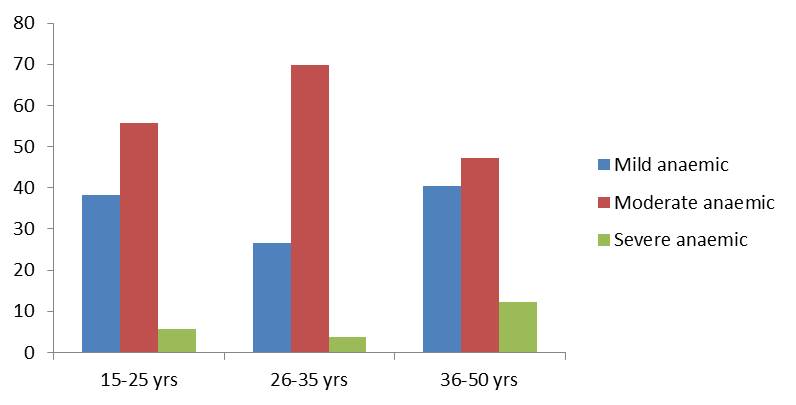
Figure 2. Percentages of different age group of women of reproductive age for mild, moderate and severe anaemia
The results show that out of 343 females randomly selected, 269 that means 78.42 % are found to be anaemic (Table 3 and 4; Figure 1 and 2). Around 82.58 % of women of 26-35 years of age are anaemic which is the highest in all three age groups. This is the age where most of the women bear children. Out of the anaemic women of this age group 69.72% are found to be moderately anaemic. In the age group of 36-50 years an alarmingly high percentage of 12.16% are found to be severely anaemic. It is indicative of the trend of falling Hb levels with age advancement. This trend may be correlated with presence of diseases or disorders, nutritional deficiencies or may be related with factors contributing to low absorption of iron in the body.
Conclusion
The results obtained are alarming owing to prevalence of anaemia in high percentage in women of child bearing age. It needs to be addressed by means of counseling, dietary assistance, awareness towards female nutritional requirements and screening for the presence of diseases or disorders leading to anaemia. It may be kept in mind that Anjar - Adipur – Gandhidham complex is considered to be a developed area with a good lifestyle index. Yet the results obtained are alarming which indicate poor women health in the region.
It is proposed that more detailed study to determine the prevalence, factors, genetic correlations associated with anaemia gene is required for a comprehensive study on the important subject which is also addressed in the countries’ health policy.
Conflicts of interest: Nil
References
ICMR Evaluation of National Anaemia Prophylaxis Programme. 1989. ICMR task force study. Indian Council of Medical Research, New Delhi,
Majid S, Ali F, Mohammad L, Elham A. 2013. Journal of Family and Reproductive Health, 7(3):139–144.
Mawani M, Ali SA, Bano G, Ali SA. 2016. Iron Deficiency Anemia among Women of Reproductive Age, an Important Public Health Problem: Situation Analysis. Reproductive System and Sexual Disorders, 5(3).
Mishra P, Ahluwalia, Garg PK, Kar R, Panda GK. 2012. The Prevalence of Anaemia among Reproductive Age Group (15-45 Yrs) Women in A PHC of Rural Field Practice Area of MM Medical College, Ambala, India. Jounal of Women’s Health Care, 1(3).
National Nutrition Monitoring Bureau (NNMB), (1975-2006) 2008. NNMB Reports. National Institute of Nutrition, Hyderabad.
Planning Commission Five-Year Plan (2002-2007). 2002. Sectoral policies and programmes. Tenth five year plan 2002-07, New Delhi.
Ramachandran P. 1989. Nutrition in Pregnancy. Women and nutrition in India, Nutritio Foundation of India, 153-193.
World Health Organization. Iron deficiency anaemia: assessment, prevention, and control (2001). A guide for programme managers. (WHO/NHD/01.3).