Kouakou S. Landry1, Yao-Kouassi Philomène Akoua2,3, Koffi Kouamé Jean-Michel2, Kimou Anderson Claver2, Kouakou-Siransy Gisèle2
1Laboratoire de Pharmacologie, UFR Sciences Pharmaceutiques, Université FHB, 01 BP V34 Abidjan, Côte d’Ivoire
2Laboratoire de Constitution et Réaction de la Matière, UFR Sciences des Structures de la Matière et de Technologie, Université Félix Houphouët-Boigny, 22 BP 582 Abidjan, Côte d’Ivoire.
3Université de San Pedro, BP V1800 San Pedro, Côte d’Ivoire
*Address for Corresponding Author
Kouakou S. Landry
Laboratoire de Pharmacologie, UFR Sciences Pharmaceutiques, Université FHB, 01 BP V34 Abidjan, Côte d’Ivoire
Abstract
Objectives: S. afzelii aqueous leaves extract is used in traditional Ivorian medicine to fight against gastric disorders, colic, dysentery and kidney problems. This study aimed was to compare decoction and methanolic phytochemical composition of S. afzelii extracts from aerial parts and evaluate anti-inflammatory potential of this plant, in order to bring out solid scientific argument which can justify its use in many pathologies. Methods: Phytochemical screening of aqueous decoction and hydro methanolic extracts obtained from leaves of S. afzelii was evaluated with standard methods. Aqueous decoction was submitted first in rat's paw irritation test induced by formalin and secondary rat's paw oedema induced by carrageenan test was performed to appreciate anti-inflammatory activity. Results: Qualitative phytochemical screening showed presence of tannins, saponins, flavonoids, sterols, terpenoids and coumarins in both extracts. All doses evaluated in formalin test (25-50-100 and 200 b.wt.) have reduced significantly production of chemical inflammation mediators respectively up to 59.09%; 54.22%; 54.10% and 62.88% with an effect comparable to ketoprofen which was 55.56%. Concerning carrageenan-induced oedema test, strong limited oedema evolution was observed at 10 b.wt., with 60.28%, 66.92%, 61.30% and 45.29% respectively at 1st, 2nd, 3rd and 4th hours. However, these effects are not superior to ketoprofen, which decrease during 4 hours up 71.35, 73.69, 68.87 and 57.06%. Conclusion: Aqueous leaves and hydro methanolic extracts of S. afzelii revealed presence of flavonoids, saponins, sterols, terpenoids, tannins and coumarins. Aqueous leaves of S. afzelii possessed good anti-inflammatory potential.
Keywords: Secamone afzelii, phytochemical screening, inflammation, formalin, carrageenan
Introduction
Vegetables plant kingdom is an inexhaustible source of drugs used for primary health care, particularly in low-income countries due to the high cost of conventional drugs (Zabri et al., 2009). S. afzelii (Roem. & Schult.) K. Schum, a creeping wood plant climber of Asclepiadaceae family (Gill, 1992; Magid et al., 2016), is used in traditional Ivorian medicine to treat painful manifestations of gastric origin, colic, dysentery and kidney problems (Abere et al., 2012). Previous phytochemical studies carried out by our team and other researchers revealed that this plant was rich in secondary metabolites like flavonoids (Zabri, 2008; Magid, 2016), coumarins (Zabri et al., 2009) and tannins (Mensah, 2014).
In contrast, few studies have reported the power of S. afzelii against inflammatory manifestations, so that the objective of this study was to screen phytochemical constituents of decoction and hydro methanolic extracts and evaluate anti-inflammatory potential of this plant, in order to provide scientific evidence which would justify its use against several pathologies.
Material and methods
Plant material
Aerial parts of S. afzelii were collected in july 2022 on the town of Cocody-Abidjan (Ivory Coast). The plant has been identified at the Floristic National Center (CNF) of the University Félix Houphouët-Boigny Cocody (UFHB), Ivory Coast, where a voucher specimen under the number: UJCJ002631 has been deposited.
Experimental animals
Study was conducted out on male and female rats (Rattus norvegicus) whose weight varied between 100 g and 210 g. These animals were provided from laboratory of Pharmacology, Clinical Pharmacy and Therapeutics (UFR SPB of Felix Houphouët-Boigny University of Abidjan - Ivory Coast). All animals under experimentation were maintained in controlled environmental conditions of 24 ± 1°C with a 12 h cycle of light and dark. The animals were kept in spacious and hygienic cages and had free access to water and pellet food provided by Animal Feed Manufacturing Society (FACI®) of Ivory Coast.
Chemicals and solvents
Phytochemical screening
Two extracts were obtained from leaves of S. afzelii. The first is obtained from dried powdered leaves and the second from fresh leaves. The dried and powdered aerial part of S. afzelii (100 g) were macerated with aqueous-MeOH 80% during 24 h with 500 mL. Fresh aerial parts of S. afzelii were boiled (500 g in 1.5 L of water) during 1 hour to comply with traditional healers’ procedures. Aqueous decoction and methanolic were evaporated under vacuum pressure to obtain 12 g and 2 g of dry extracts respectively. Qualitative phytochemical screening was done to evaluate major phytochemical constituents such as flavonoids, coumarins, saponins, alkaloids, sterols, terpenoids, and tannins using standard procedure of analysis as described in literature (Mamyrbekova-Bekro et al., 2008; Bekro et al., 2008). Detection of alkaloids was carried out using Dragendorff reagent. Catechic tannins characterization was realized using Stiasny reagent. Gallic tannins were detected by adding Stiasny reagent to sodium acetate and FeCl3. Flavonoids were detected with cyanidin reaction. Coumarins were detected by adding KOH. Concerning detection of triterpenes and sterols, Liebermann-Büchard reagent was used. Saponins were characterized by measuring index of foam.
Preparation of Formaldehyde (2.5%v/v) solution
1ml of 37% formaldehyde solution was homogenized in 13.8 ml of physiological saline solution (0.9% NaCl).
Preparation of Carrageenan (1%w/v) solution
10 mg of pure carrageenan powder was homogenized in 10 ml of physiological saline solution (NaCl 0.9%).
Pharmacological tests
Formalin induced rat paw irritation test
The method performed was described by Dubuisson with some modifications (Tjolsen, 1992; Dubuisson, 1997). This test specific to confirm analgesic activity is based on determine licking time of rat’s paw previously treated with substances evaluated after cause paw irritation by injection of formalin 2.5%. The licking time of the paw was counted for five minutes after the application of formalin, and then counted for fifteen minutes after ten minutes corresponding to the intermediate period of latency. A control and reference group were performed and receive respectively water and ketoprofen. The injection of a phlogogenic substance (formalin) under posterior plantar aponeurosis paw set off an inflammatory syndrome painful, manifests itself into two phases: (i) a neurogenic phase (phase 1) ranging from 0 to 5 minutes followed by (ii) a late or inflammatory phase (phase 2) ranging from 15 to 30 minutes after the application of the stimulus.
Preventive administration of substances with analgesic properties decrease paw licking time by inhibiting pain during phase 1, while those with anti-inflammatory properties stop extension of inflammatory phenomena during phase 2. On experimentation day, 36 rats were divided into six (6) homogeneous weight groups of six (6) rats per group. The solutions were administered to animals using an oral gavage at rate of 1ml/100g p.c., as follows:
- Group 1 (Control): rats treated with NaCl 0.9%
- Group 2 (Reference): rats treated with 10 b.wt. of ketoprofen;
- Group 3 (Test 1): rats treated with 25 b.wt. of extract;
- Group 4 (Test 2): rats treated with 50 b.wt. of extract;
- Group 5 (Test 3): rats treated with 100 b.wt. of extract;
- Group 6 (Test 4): rats treated with 200 b.wt. of extract;
In each group percentage of inflammatory syndrome was calculated according to the following formula

Carrageenan-induced oedema test
Method performed was described by Winter (Winter, 1962). This specific test to confirm the anti-inflammatory activity is based on measure oedema volume of rat’s paw previously treated with substances evaluated after having caused oedema with injection of carrageenan 1%. Oedema volume evolution was measured at 1h, 2h, 3h and 5h after injection of 1% carrageenan. Preventive administration of an anti-inflammatory substance reduces oedema volume of rat’s paw. A control and reference group were performed and receive respectively water and ketoprofen. On experimentation day, 30 rats were divided into six (6) homogeneous weight groups of six (6) rats per group. The solutions were administered to animals using an oral gavage at rate of 1ml/100g p.c., as follows:
- Group 1 (Control): rats treated with NaCl 0.9%;
- Group 2 (Reference): rats treated with 10 b.wt. of ketoprofen;
- Group 3 (Test 1): rats treated with 5 b.wt. of extract;
- Group 4 (Test 2): rats treated with 10 b.wt. of extract;
- Group 5 (Test 3): rats treated with 20 b.wt. of extract;
In each group percentage of inflammatory syndrome was calculated according to the following formula:

A = Average of the values obtained
Ct= Circumference of paw at a time t
Co = Initial circumference of the paw
Ethical approval
Experimental procedures were carried under approval by the Ethics Committee for Animal Resources of the University (Ivory Coast). All test realize were in strict accordance with animal’s care guidelines and declarations of European Union concerning handling of laboratory animals (Louhimies, 2002).
Conflicts of interest
The authors have declared that no competing interests exist.
Statistical Method
Data were analysed using Graph Pad Prism® 8.0 software. Kruskal-wallis statistical test compared mean values ± SD (standard deviation) by analysis of variance (ANOVA) at risk α = 0.05. Codification for statistically significant difference was: * = p ≥ 0.01; ** = 0.001; p ≤ 0.01; *** = p ≤ 0.001
Results
Phytochemical constituents
Phytochemical screening showed presence of tannins, saponins, flavonoids, sterols, terpenoids, and coumarins in aqueous decoction and methanolic extracts. However, no alkaloids were detected in both extracts (Table 1).
Secondary metabolites recognised were same in both extracts, so that our next investigation on animals’ experimentation were performed using decoction because it is the most preparation used according to traditional healers’. Thus, aqueous extract was used to prepare stock solution and range concentration tested at 5, 10, 20, 25, 50, 100 and 200 b.wt.
Table 1. Results of phytochemical screening of aqueous decoction and methanolic extracts of aerial part of S. afzelii
|
Class of compounds |
Flavonoids |
Coumarins |
Saponins |
Alkaloids |
Tannins |
Sterols and triterpenes |
|
Aqueous extract |
+ |
+ |
+ |
- |
+ |
+ |
|
Methanol extract |
+ |
+ |
+ |
- |
+ |
+ |
(+) shows presence and (-) confirms absence of phytoconstituents
Effect of extract after formalin administration
On first time (T 5min) extract under study did not significantly inhibit rats’ pain. In contrast, during late time (T 30min), all doses tested 25-50-100 and 200 b.wt., had significantly limited production of chemical inflammation mediators respectively up to 59.09%; 54.22%; 54.10% and 62.88% with an effect comparable to ketoprofen which was 55.56%.
Effect of extract after carrageenan administration
Extract dose at 5 b.wt., significantly inhibited oedema induced by carrageenan during 2 hours with an effect close to 61.56% and 45.52% respectively at 1st and 2nd hours. Concerning dose at 10 b.wt., oedema inhibition was lasted for 4 hours, up to 60.28%, 66.92%, 61.30% and 45.29% respectively at 1st, 2nd, 3rd and 4th hours.
Discussion
Phytochemical analysis
Phytochemical analysis of samples was reported in Table 1. Results showed that flavonoids, sterols, terpenoids, tannins, coumarins and saponins were present in methanol and aqueous decoction extracts. These results are similar with to other researchers (Zabri et al., 2008; Zabri et al., 2009; Magid et al., 2016). Presence of these constituents may support reported medicinal use of this plant. These secondary metabolites have also been detected in Secamone genus (Sekandi et al., 2020), a plant of the same family of S. afzelii, which confirms its chemotaxonomics.
Polyphenolic compounds including flavonoids, tannins and coumarins receive increased attention because in recent years a significant number of studies have demonstrated their potential benefits for human health. Among polyphenols, most abundant flavonoids and coumarins are known for their antioxidant, anti-inflammatory and anti-microbial activity (Maleki et al., 2019; Bansal et al., 2013; Garcıa-Lafuente et al., 2009; Kim et al., 2004). Tannins are biomolecules known for their astringent properties which bind and precipitate proteins and various other organic compounds, including amino acids and alkaloids responsible of its multiple biological activities, such as anti-inflammatories (Wu et al., 2023; Park et al., 2013; Okuda et al., 2011).
Triterpenoids and sterols are a family of organic compounds found in plants and trees that exhibit interesting biological properties such as analgesic and anticonvulsant activities. Also, several studies have shown that these terpene compounds reduce inflammatory symptoms (Ge et al., 2022; Prakash et al., 2017; Kashyap et al., 2016).
Plants containing saponins are used to heal wounds and also possess anti-inflammatory activities (Costa et al., 2011; Zheng et al., 2022).
Anti-inflammatory effect
Formalin-induced rat paw irritation test is non-specific test widely used to screen analgesic, anti-inflammatory and relaxant substances (Koster, 1969). Injection of this phlogogenic substance into rat paw had directly stimulated free nerve endings (neurogenic phase: phase 1) with production of full chemical pain mediators such as substance P, histamine, serotonin and bradykinin (Parada, 2001), which secondarily accelerate prostaglandins, cytokines and molecules like IL-1β, IL-6, TNF-α (Minghetti, 2004; Bartels, 2010) production responsible of the inflammation (inflammatory phase: phase 2) (Hunskaar, 1987). Narcotic analgesics (Tjolsen, 1992) inhibit both phases (phase 1 and 2), while nonsteroidal anti-inflammatory drugs such as ketoprofen only inhibit late phase (phase 2).
Results obtained after realise this formalin test showed that extract evaluated did not significantly inhibit rats’ pain (phase 1) allowing us to think that aqueous extract of S. afzelii had no analgesics properties. It was at second phase (phase 2) that all doses tested revealed significant anti-inflammatory effect by limited production of chemical inflammation mediators respectively involve in the persistence of pain (Figure 1). Hypothesis that doses under 25 b.wt. could still be effective, it was important to performing carrageenan test using lower range doses around 5, 10 and 20 b.wt., not only to find most effective dose but also to confirm extract anti-inflammatory potential because carrageenan test is a specific test to evaluate anti-inflammatory properties of substances. Carrageenan test confirms that dose of 5 b.wt., significantly inhibited oedema induced by carrageenan during 2 hours. Most remarkable effect was observed at 10 b.wt., which lasted for 4 hours like reference substance (kétoprofène 10 b.wt.) (Figure 2 and 3). These results prove that it makes sense to support high probability that aqueous extract of S. afzelii possess anti-inflammatory properties and this potential could be attributed to polyphenolic (Mensah et al., 2014, Bansal et al., 2013; Zabri et al., 2009; Kim et al 2004) and triterpenoid compounds (Jeong et al., 2014; Prakash et al., 2017) which acts in synergy to developed biopharmacological effects responsible of its anti-inflammatory potential. Ours results are similar compared to those obtained by Mensah (Mensah, 2014). The charm of our investigations is that effect was revealed at low doses close to 10 b.wt., while those of Mensah were obtained at higher concentrations up to 300 b.wt. with 44.26% inhibition of oedema induce by carrageenan.
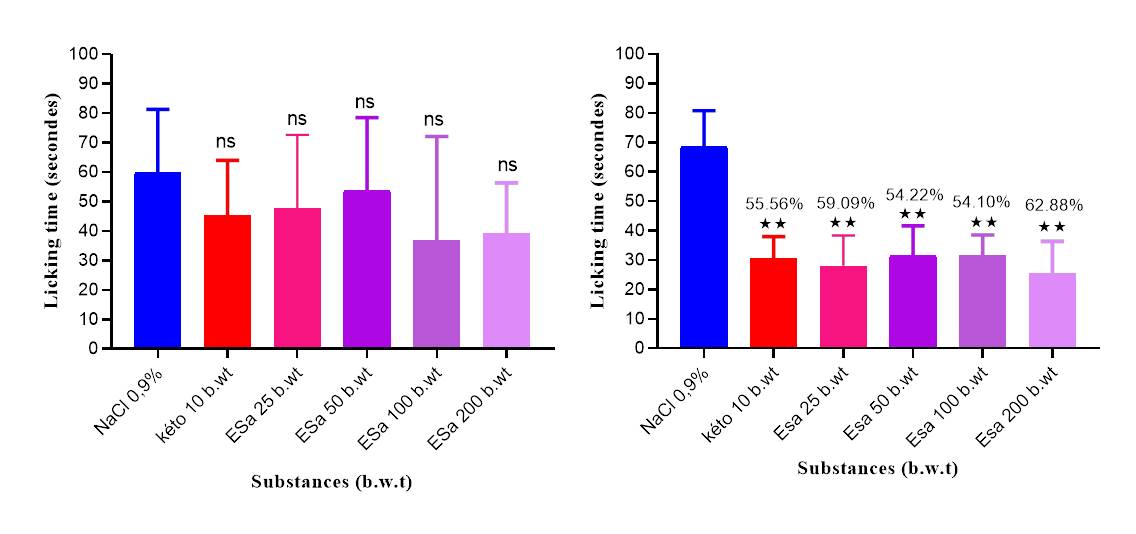
Figure 1. Effect of extracts after administration of formalin agent. Test de Kruskal-wallis, Values expressed on average ± SD (standard deviation); Neurogenic phase: No significant difference rat paw licking time compared to Control; Inflammatory phase: significant difference rat paw licking time compared to Control: Kéto 10 b.wt.**(p = 0,0003) ; ESa 25 b.wt.;**(p = 0,0013) ; ESa 50 b.wt.; **(p = 0,0016) ; ESa 100 .;**(p =0,0023) ; ESa 200 b.wt.; **(p =0,0026)
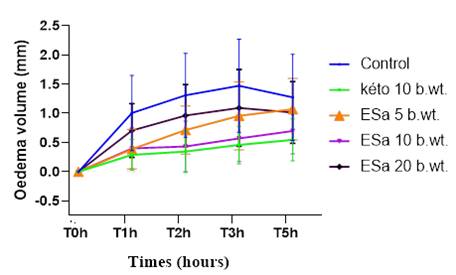
Figure 2. Effect of extracts after formalin injection
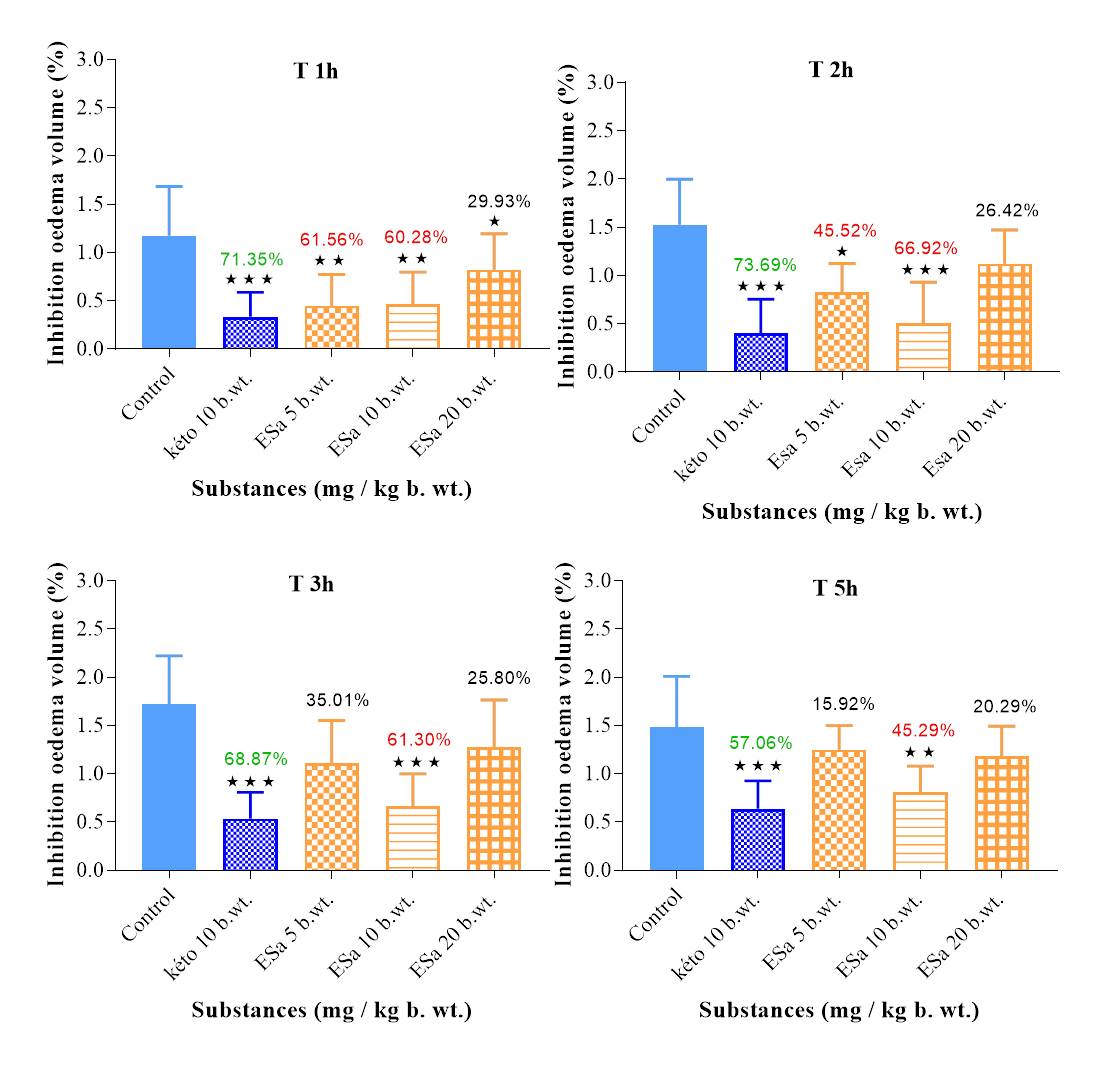
Figure 3: Evolution of inhibition paw volume oedema after of administration of extracts. Test de Kruskal-wallis, Values expressed on average ± SD (standard deviation). Values expressed on average ± SD (standard deviation); ***, **, *: Significant difference rat paw licking time compared to Control: T 1H: Kéto 10 b.w.t. ***(p = 0,0013); ESa 5 b.w.t **(p = 0,0080); ESa 10 b.w.t **(p = 0,0094); ESa 20 b.w.t (p =0,0194); T 2H: Kéto 10 b.w.t ***(p = 0,0003); ESa 5 b.w.t *(p = 0,0153); ESa 10 b.w.t **(p=0,0004); T 3H: Kéto 10 b.w.t ***(p = 0,0002); ESa 10 b.w.t *** (p = 0,0007); T 5H: Kéto 10 b.w.t ***(p = 0,0009); ESa 10 b.w.t ** (p = 0,0081.
Conclusion
Aqueous leaves of S. afzelii revealed presence of flavonoids, saponins, sterols, terpenoids, tannins and coumarins and possessed good anti-inflammatory potential. Our study provided scientific evidence which support traditional use of S. afzelii aqueous extract in treatment of pathologies with low to moderate inflammatory components. However, biological other activities must be carried out for more effective and efficient use of this plant. Production of a finished product with acceptable microbiological quality followed by clinical study in humans will be the next steps to make, before allow in security S. afzelii aqueous extract as a potential phytomedicine candidate.
Conflict of interest: None
References
Abere T, Onwukaeme D. 2012. Pharmacognostic Evaluation of the Leaves of Secamone afzelii (Schult) K Schum (Asclepiadaceae). Tropical Journal of Pharmaceutical Research, 11(1):125-131.
Bansal Y, Sethi P, Bansal G. 2013. Coumarin: a potential nucleus for anti-inflammatory molecules. Medical Chemistry Research, 22:3049–3060.
Bartels A, Leenders K. 2010. Cyclooxygenase and neuroinflammation in Parkinson’s disease neurodegeneration. Current Neuropharmacology, 8:62-68.
Bekro Y, Bekro M, Boua B, Tra Bi F, Ehile E. 2007. Etude ethnobotanique et screening phytochimique de Caesapinia bentaminina (Baill). Herend et Zarucchi (Caesalpiniaceae). Sciences et Nature, 4:217-225.
Costa F, Yendo A, Fleck J, Gosmann G, Fett-Neto A. 2011. Immunoadjuvant and Anti-Inflammatory Plant Saponins: Characteristics and Biotechnological Approaches Towards Sustainable Production. Mini-Reviews in Medicinal Chemistry, 11,857-880.
Dubuisson D, Dennis S. 1997. The formalin test: A quantitative study injected limb, was determined at which the rat would give of the analgesic effects of morphine, meperidine, and brain stem a vocal response. Pain, 4:161–77.
Garcıa-Lafuente A, Guillamon E, Villares A, Rostagno M, Martinez J. 2009. Flavonoids as anti-inflammatory agents: implications in cancer and cardiovascular disease. Inflammation Research, 58:537–552.
Ge J, Liu Z, Zhong Z, Wang L, Zhuo X, Li J, Xi Ji, Xi-Ya Ye, Ti Xi, Re Ba. 2022. Natural terpenoids with anti-inflammatory activities: Potential leads for anti-inflammatory drug discovery. Bioorganic Chemistry, 24:105817.
Gill L. 1992. Ethnomedical uses of plants in Nigeria. University of Benin Press, Benin City, Nigeria, 103.
Hunskaar S, Hole K. 1987. The formalin test in mice: dissociation between inflammatory and non-inflammatory pain. Pain, 30:103–14.
Jeong G-S, Bae J-S 2014. Anti-Inflammatory Effects of Triterpenoids; Naturally Occurring and Synthetic. Organic Chemistry 11:316-329.
Kashyap D, Sharma A, Tuli H, Punia S, Sharma A. 2016. Ursolic Acid and Oleanolic Acid: Pentacyclic Terpenoids with Promising Anti-Inflammatory Activities. Recent Patents on Inflammation & Allergy Drug Discovery, 10(1):21-33.
Kim H, Son K, Chang H, Kang S. 2004. Anti-inflammatory Plant Flavonoids and Cellular Action Mechanisms. Journal of Pharmacology Science, 1-18.
Koster R, Anderson M. 1959. Acetic Acid for Analgesic Screening. Federation Proceedings, 18:412.
Louhimies S. 2002. Directive 86/609/EEC on the protection of animals used for experimental and other scientific purposes. Alternatives to Laboratory Animals. 30(2):217-219.
Magid A, YAO-Kouassi P, Diane P, Apie G, Claire M. 2016. Laurence Voutquenne-Nazabadioko New antioxidant flavonoids from the aerial parts of Secamone afzelii. Journal of antioxidant activity, 1(2): 8-16.
Maleki S, Crespo J, Cabanillas B. 2019. Anti-inflammatory effects of flavonoids. Food Chemistry, 125-124.
Mamyrbekova-Bekro J, Konan K, Bekro Y, Djie Bi M, Zomi Bi T, Mambo V, Boua Boua B. 2008. Phytocompounds of the extracts of four medicinal plants of Côte d’Ivoire and assessment of their potential 72 antioxidant by thin layer chromatography. European Journal of Scientific Research, 24(2):219-228.
Mensah A, Mireku E, et Okwuonu V. 2014. Anti-inflammatory and anti-oxidant activities of Secamone afzelii (Rhoem) Ascleipiadaceae. Journal of Medical and Biomedical Sciences, 3(1): 23-30.
Minghetti L. 2004. Cyclooxygenase-2 (COX-2) in inflammatory and degenerative brain diseases. Journal of Neuropathology & Experimental Neurology, 63:901–910.
Okuda T, Ito H. 2011. Tannins of Constant Structure in Medicinal and Food Plants -Hydrolyzable tannins and polyphenols related to tannins. Molecules, 16:2191-2217.
Parada C, Tambeli C, Cunha F. 2001. The major role of peripheral release of histamine and 5-hydroxytryptamine in formalin-induced nociception. Neuroscience, 102(4):937-44.
Park M, Cho H, Jung H, Lee H, Hwang K. 2013. Antioxidant and Anti-Inflammatory Activities of Tannin Fraction of the Extract from Black Raspberry Seeds Compared to Grape Seeds. Journal of Food Biochemistry, 38:259-270.
Prakash V. 2017. Terpenoids as source of anti-inflammatory compounds. Asian Journal of Pharmaceutical and Clinical Research. Asian Journal of Pharmaceutical and Clinical Research, 10 (3):68-76.
Sekandi P, Namukobe J, Byamukama R, Akala H, Yeda R, Heydenreich M. 2020. Bioactive secondary metabolites from the leaves of Secamone africana (Olive) Bullock. International Journal of Biological and Chemical Sciences, 14(5):1820-1830.
Tjolsen A, Berge O, Hunskaar S. 1992. The formalin test: an evaluation of the method. Pain, 51:5-17.
Winter C, Risley E, et Nuss W. 1962. Carrageenin-induced oedema in hind paw of the rat as an assay for anti-inflammatory drugs. Proceedings of the Society for Experimental Biology and Medicine, 111:544-547.
Wu K, Fu M, Zhao Y, Gerhard E, Li Y, Yang J, Guo J. 2023. Anti-oxidant anti-inflammatory and antibacterial tannin-crosslinked citrate-based mussel-inspired bioadhesives facilitate scarless wound healing. Bioactive Materials, 20, 93-110.
Zabri H, Kodjo C, Anoubile B, Janat M, Yves A. 2008. Phytochemical screening and determination of flavonoids in Secamone afzelii (Asclepiadaceae) extracts. African Journal of Pure and Applied Chemistry, 2:080-082.
Zabri H, Kabran GR, Kodjo C, Tra B. 2009. Purification and characterization of a coumarin in methanolic leaf extracts of Secamone afzelii (Asclepiedacea) from Côte d'Ivoire. Journal of Animal & Plant Sciences, 3:182-185.
Zheng Y, Fan C, Chen Y, Quan J, Shi L, Shang X, Xu N, Ye W, logo O, Yu J, Liu J. 2022. Anti-inflammatory, anti-angiogenetic and antiviral activities of dammarane-type triterpenoid saponins from the roots of Panax notoginseng. Food & Function, 13:3590-3602.