Rajit Kumar1, Suresh Janadri*2, Santosh Kumar1, Dhanajaya D R1, Shivakumar Swamy1
1 Department of Pharmacology, Mallige College of Pharmacy, Bangalore (Karnataka), India.
2 Department of Pharmacology, Acharya B.M, Reddy College of Pharmacy, Bangalore (Karnataka), India
*Address for Correspondence:
Dr. Suresh Janadri
Department of Pharmacology
Acharya & B.M Reddy College of Pharmacy
Acharya Dr. Sarvepalli Radhakrishnan Road
Acharya Post Office, Soldevanahalli
Hessarghatta Main Road, Bangalore - 560 107
Karnataka, India
Tel: +91-9591138301
Fax: +91-80-28393541
Email: sureshjanadri@gmail.com
Abstract
Objective: S.grandiflora flower has been used in folk medicine of India and Nepal for the treatment of diabetes mellitus. However, no scientific evidence has been available to support its use of flower part in traditional medicine. The present study was conducted to investigate the antidiabetic activity of 70% alcoholic extract of S.grandiflora flower in alloxan induced diabetes rats. Materials and Methods: Antidiabetic activity was screened in alloxan induced diabetic rats at dose of 250 mg/kg and 500 mg/kg of the 70% alcoholic extract of S.grandiflora flower for 28 days per orally. Glibenclamide (0.5 mg/kg, p.o.) used as the standard drug was administered for 28 days. The fasting blood glucose was measured at 1st, 7th, 14th and 28th day by glucometer and biochemical parameters are serum total cholesterol, triglyceride, SGOT, SGPT and BUN were assessed by semiautoanyser using biochemical kits. At the end of 28th day, pancreases were isolated for histopathology. Results: The alcoholic extract at the dose of 250 and 500 mg/kg of S.grandiflora flower exhibited significant (p<0.01) antidiabetic activity compared to diabetic control. Further the extract of both doses showed significant (p<0.01) reduction of serum total cholesterol, triglyceride, SGOT, SGPT and BUN in diabetic rats compared to diabetic control. Conclusion: The study indicates that 70% alcoholic extract of S. grandiflora flower possesses an antidiabetic activity in dose dependent manner in diabetic rats.
Keywords: S. grandiflora, Flower, Alloxan, Antidiabetic
Introduction
Diabetes mellitus is the most common pancreatic islet disorder caused by an inability to produce insulin or a defect in utilization. The feature of diabetes mellitus is polyuria, polydipsia, weight loss and polyphagia. It is also characterized by chronic hyperglycemia and glucosuria, caused by an absolute or relative deficiency of insulin (Sharma and Kumar, 2011). This may results into the development of further complications which include hypertension, atherosclerosis, ketosis, gangrene and microcirculatory disorders (Edem, 2009). It is also associated with long-term complications including retinopathy, nephropathy, neuropathy and angiopathy (Kristova et al., 2008).
The number of cases of diabetes worldwide in 2000 among adults 20 years of age is estimated to be 171 million. This figure is 11% higher than the previous estimate of 154 million. The IDF (International Diabetes federation) has subsequently released estimates of the numbers of people with diabetes for 2003 and forecasts for 2025 of 194 million and 334 million, respectively (Hyashi et al., 2002). India leads the world with largest number of diabetic subjects earning of term “diabetes capital of the world”.
Glucose lowering drugs usually succeed in lowering blood sugar levels, therapeutic agents like insulin, sulfonylureas, biguanides and thiazolidinedione derivatives are used. However, on chronic usage most of these agents produced several side effects including hypoglycemic coma, insulin resistance, hyper-sensitivity, jaundice, abdominal pain, anorexia and metallic taste (Chaudhary, 2001). Because of the high mortality and morbidity arising from its attendant complications and problems associated with the use of conventional antidiabetic agents. In this regard, herbal remedies can improve diabetic conditions without side effects (Adeneye et al., 2006).
There has been increasing demand for the use of plant products with antidiabetic activity due to low cost, easy availability and lesser side effects. Therefore, plant materials are continuously scrutinized and explored for their effect as hypoglycemic agents. Among that one of the plant, S. grandiflora has been used as folk medicine in diabetes. S. grandiflora consists of dried bark of the plant belongs to family Leguminosae and distribution in many Asian countries like India, Malaysia, Indonesia and Filipinas (Glenn, 1972; Nadkarni, 1999).
According previous studies of S. grandiflora exhibited the antioxidant activity and antiurolithiatic activity (Doddola et al., 2008), anticancer and chemopreventive activity (Laladhas et al., 2009), anxiolytic activity and anticonvulsive effect (Kasture et al., 2002), hepatoprotective activity (Pari and Uma, 2003), cardioprotective effect (Thiyagarajan et al., 2008), antiulcer activity (Serti et al., 2001), antimicrobial activity (Vipin et al., 2011), analgesic and antipyretic activity (Tamboli et al., 2000), diuretic, CNS depressant and laxative (Rajasekaran and Murugesan, 2003), hypolipidemic activity (Saravanakuma and Vanitha, 2010), anthelmintic activity (Karthikeyan et al., 2011) and wound healing effect (Karthikeyan et al., 2010). After thorough literature review, there is lack of research work reported on flower part of S. grandiflora for antidiabetic activity. Hence, the present research focused on evaluating the antidiabetic activity of 70% alcoholic extract of S. grandiflora flower in alloxan induced diabetic rats.
Materials and Methods
Plant material and preparation of extract
The flowers of Sesbania grandiflora were collected from the surrounding gardens of FRLHT (Foundation for Revitalisation of Local Health Traditions) Jarakabande Kaval, Attur Post, Bangalore-560106, India. The flowers of S. grandiflora was identified and authenticated by Dr. K. Ravikumar, Senior Botanist at FRLHT. A herbarium specimen was preserved in the college museum for future reference. The flowers were shade dried separately at room temperature and pulverized. The flower of S. grandiflora were chopped into small pieces and dried under shade at room temperature for seven days. The dried flower were powdered and passed through the sieve (coarse10/40). The powder was stored in an air tight container for further use. The powder was used for the preparation of alcoholic extract.
Petroleum ether extraction
The extraction with non-polar solvent like petroleum ether for the purpose of defatted. Extraction carried out by continuous hot extraction method using soxhlet extractor till all constituent were removed. The end of completion of extraction was indicated by no colour with iodine in iodine chamber. After completion of extraction, solvent was distilled out and dried extract was obtained. Extract was kept in desiccators for further use. Petroleum ether extract mainly contain colouring matter like chlorophyll, carotenoids, lipids, free sterol and triterpenes.
Alcoholic extraction
The marc after exhaustive petroleum ether extraction was air-dried and subjected to exhaustive soxhlet extraction with 70% alcoholic. The end point of extraction was determined by reaction with iodine vapours. After the effective extraction, the solvents were distilled off, the extracts was concentrated on water bath and weighed. The percentage yield was calculated on died weight. The 70% alcoholic extract flowers of S. grandiflora tested for phytochemical analysis for bioactive compounds (Kokate CK, 1999)
Experimental animals
Albino Wistar rats of either sex with 150–200 g of body weight purchased from Bioneeds, Tumkur and kept in polypropylene cages. The animals were maintained in the 12 hour light/dark cycle, 23±2º C temperature and relative humidity 55 to 70%. Amrut pellet food and water was supplied ad libitum. After two weeks of acclimation period male and female rats were used for study. Institutional Animal Ethical Committee (IAEC) of Mallige College of Pharmacy (Reg. no. 1432/PO/a/11/CPCSEA), Bangalore has approved the protocol (Ref.No: IAEC/MCP/2012-13/05) to carry out the antidiabetic activity in experimental rats.
Acute toxicity
The acute oral toxicity study was performed according to the Fixed dose (OCED Guideline No. 420) method of CPCSEA was adopted for toxicity studies.
Induction of diabetes in rats and design of experiment
Diabetes was induced in the rats by administering alloxan monohydrate (120 mg/kg, i.p.) into the 24 hour fasted rats (Venkatesh et al., 2003). Blood samples were collected after 24 hours and blood glucose levels were estimated. Albino rats which have shown more than 200 mg/dl blood glucose levels were considered as diabetic animals. The blood glucose levels were monitored for further four days. It was confirmed that diabetes was induced in 24 hours and stabilized within 4 days. These animals were used for antidiabetic activity (Janadri et al., 2009).
The diabetic animals were randomly divided into 5 group consist of 6 animals. Group-I received vehicle only, Group-II Diabetic control received vehicle only, Group-III was treated with Glibenclamide (0.5 mg/kg, p.o), Group-IV was treated with 70% alcoholic extract of S. grandiflora (250 mg/kg, p.o), Group-V was treated with 70% alcoholic extract of S. grandiflora (500 mg/kg, p.o) for 28 days. Blood samples were drawn by retro-orbital puncture and fasting blood glucose levels were estimated on 1st, 7th, 14th, 21st and 28th day using Digital Glucometer (Bayer Company) and lipid profiles, SGOT, SGPT and BUN were determined on 28th day of experiment.
Biochemical estimation
The blood samples were collected without any anticoagulant and were allowed to clot for 45 minutes at room temperature. The blood was centrifuged at 2500 rpm for 15 minutes at 30°C. The obtained serum was used for estimation of total cholesterol, triglyceride, SGOT, SGPT and BUN. Estimations were carried out according to the standard procedures given by biochemical kit. The rats were then sacrificed on end of 28th day and the sections of pancreas were isolated for histopathology.
Statistical analysis
Data were expressed as mean ± standard error of mean. Statistical comparisons were made by using one-way ANOVA followed by Dunnet test. The results were considered statistically significant if P < 0.05, P < 0.01, P < 0.001.
Results
Phytochemical analysis
The 70% alcoholic extract of flower of S. grandiflora were subjected to qualitative test to identify the presence of phytoconstituents. The results of phytochemical analysis of 70% alcoholic extract of flowers of S. grandiflora shows presence of tannins, amino acids, glycosides, phytosterols, flavonoids and sugars.
Effect of 70% alcoholic extract of S. grandiflora flower on blood glucose in diabetic rats
The 70% alcoholic extract of S. grandiflora flower were screened for antidiabetic activity in alloxan induced diabetic rats and the results was shown in Table 1. The standard drug glibenclamide (0.5 mg/kg, p.o.), was shown significant (P<0.05) decrease in blood glucose level at 14th, 21st day and more significant (P<0.001) decrease in blood glucose at 28th day compared to diabetic control. The 70% alcoholic extract of S. grandiflora flower at a dose of 250 and 500 mg/kg/day reduced blood glucose level significant (P<0.05) at 14th day of the treatment and more significant (P<0.01) at 21st and 28th day of treatment in diabetic rats comparison with diabetic control group.
Effect of 70% alcoholic extract of S. grandiflora flower on biochemical parameters in diabetic rats
The result of 70% alcoholic extract of S. grandiflora flower on biochemical parameters in alloxan induced diabetic rats was shown in Table 2. The alloxan induced diabetic rats showed a significant (P<0.01) hypercholesterolemia, hypertriglyceridemia and increase in level of SGOT, SGPT and BUN when it is compared with the vehicle control rats. Treatment with standard drug glibenclamide (0.5 mg/kg, p.o.) for 28 days shows significant (P<0.01) reduction in total cholesterol, triglycerides, SGOT, SGPT and BUN levels compared to diabetic control. The treatment with 70% alcoholic extract of S.grandiflora flower at the dose of 250 mg/kg and 500 mg/kg for 28 days shows significant (P<0.05) decreased the cholesterol, triglyceride, SGOT, SGPT and BUN levels compared to diabetic control. The 70% alcoholic extract of S. grandiflora flower has a potential effective in alleviating experimental diabetes and diabetes related complications.
Table 1. The effect of 70% alcoholic extract of S. grandiflora flower on blood glucose level in alloxan induced diabetic rats
|
Groups |
Treatment |
Fasting blood glucose level (mg/dl) |
||||
|
1st day |
7th day |
14th day |
21st day |
28th day |
||
|
I |
Vehicle control (5 ml/kg, p.o) |
81.28 ± 3.69 |
79.816 ± 3.45 |
80.55 ± 3.41 |
78.68 ± 3.31 |
78.35 ± 3.2 |
|
II |
Diabetic control (5 ml/kg, p.o) |
393.05 ± 3.35** |
342.46 ± 3.4** |
282.41 ± 2.65** |
254.13 ± 3.29** |
219.36 ± 3.3 |
|
III |
Glibenclamide (10 mg/kg, p.o) |
349.36 ± 3.38 |
246.15 ± 3.26 |
185.40 ± 2.70* |
143.65 ± 3.36* |
122.3 ± 3.2*** |
|
IV |
70% alcoholic extract of S. grandiflora (250 mg/kg, p.o) |
385.26 ± 3.28 |
294.06 ± 3.27 |
220.25 ± 3.61* |
169.36 ± 3.37** |
154.61 ± 2.4** |
|
V |
70% alcoholic extract of S. grandiflora (500 mg/kg, p.o) |
377.81 ± 3.38 |
275.91 ± 3.15 |
194.30 ± 2.92* |
156.33 ± 2.34** |
134.3 ± 3.3** |
|
Groups |
Treatment |
T. Cholesterol (mg/dl) |
Triglyceride (mg/dl) |
SGOT (IU/L) |
SGPT (IU/L) |
BUN (mg/dl) |
|
I |
Vehicle Control (5 ml/kg, p.o.) |
35.28 ± 1.27 |
32.46 ± 1.17 |
60.76 ± 1.02 |
49.48 ± 2.36 |
29.86 ± 2.06 |
|
II |
Diabetic control (5 ml/kg, p.o.) |
84.23 ± 2.27* |
126.65 ± 2.42** |
165.86 ± 2.41 ** |
125.16 ± 2.39** |
59.40 ± 2.31** |
|
III |
Glibenclamide (0.5 mg/kg, p.o.) |
37.20 ± 2.18** |
33.10 ± 2.99 ** |
91.86 ± 1.30 ** |
79.43 ± 1.93** |
34.22 ± 1.36* |
|
IV |
70% alcoholic extract of S.grandiflora (250 mg/kg, p.o.) |
55.26 ± 1.70 * |
90.41 ± 1.34** |
155.53 ± 2.91 |
108.85 ± 1.31 |
47.48 ± 2.13* |
|
V |
70% alcoholic extract of S.grandiflora (500 mg/kg, p.o.) |
46.25 ± 1.30* |
34.05 ± 1.52** |
111.76 ± 1.30* |
88.60 ± 1.37* |
38.12 ± 2.45* |
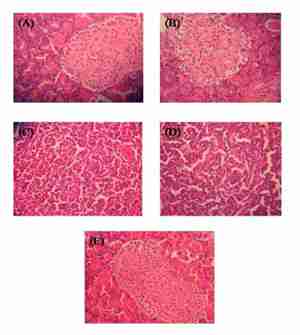
Histopathological studies were performed on both normal and alloxan induced diabetes rats, and the observations in Group-I Vehicle control, photomicrograph showed normal acini and normal cellular population in the islets of langerhans containing α, β and δ cells. β cells are in abundant cells in pancreas (Figure 1A). Group-II Diabetic control, histopathology of pancreas suggests extensive damage to the islets of langerhans and reduced dimensions of islets (Figure 1B). Group-III Glibenclamide (0.5 mg/kg, p.o.), there was a restoration of normal cellular size of islets with hyperplasia and regeneration of islets cells (Figure 1C). Group-IV 70% alcoholic extract of S.grandiflora flower (250 mg/kg, p.o.), there was a less restoration of cells of islet of langerhans, and partial regeneration of islet cells (Figure 1D). Group-V 70% alcoholic extract of S.grandiflora flower (500 mg/kg, p.o.) shown the restoration of repair of the cells of islet of langerhans and regeneration of islet cells was observed (Figure 1E).
Discussion
Management of diabetes without any side effects is still a challenge to the modern medicine. This leads to increasing the demand for searching new drugs from natural origin or nutritional products with antidiabetic and free from side effect or less side effects. The phytochemical studies on flower extract of S.grandiflora revealed the presence of tannins, saponins and flavonoids. Flavonoid and tannins isolated from the other antidiabetic medicinal plants has been found to stimulate secretion or possess an insulin like-effect (Marles JR and Farnsworth, 1995). The flavonoids present in 70% alcoholic extract of S. grandiflora flower may also be acting similarly thereby decreasing the high blood glucose levels of alloxan induced diabetic rats.
Our results are supporting its use as folklore medicine for the treatment of diabetes. Plants may act on blood glucose through different mechanisms, some of them may have insulin-like substances and some may inhibit insulinase activity (Collier et al., 1987; Chakravarthy et al., 1980). The mechanism of alloxan induced diabetes has been the subject of many investigations and it is now generally accepted that free radicals are selectively involved in the initiation of the damage that ultimately leads to β cells death (Collier et., 1987; Bopanna et al., 1997). Therefore, the pancreas is especially susceptible to the action of alloxan induced free radical damage. Many substances have been shown to ameliorate the diabetogenicity of alloxan in animals, which protect by reacting with free radicals formed from alloxan during its interaction with β cells, or preventing radical formation (Jorn et al., 1999).
Recently, it was reported that the S. grandiflora extract, exhibited significant radical scavenging activity and thus antioxidant activity and the present finding indicates that administration of S. grandiflora offers protection of vital tissues including the pancreas, thereby reducing the causation of diabetes in these animals (Ritesh and Sanmati, 2011). Therefore, protective effect of S. grandiflora flower extract on pancreas of alloxan induced diabetic rats could be attributed directly to scavenging activity and for more extent to the regenerative properties of the extract. The results of the present study indicated that 70% alcoholic extract of S.grandiflora flower exhibited dose-dependent antidiabetic activity against alloxan induced diabetes in rats. Thus justifies the traditional use of this plant in the treatment of diabetes mellitus. However, clinical studies should be performed to confirm the similar antidiabetic before put into therapy.
Acknowledgements
The authors are thankful to Dr. A.C. Raghuram and Dr. A.C. Sreeram, management of Mallige education foundation for provided necessary facility to carry out the research in laboratory.
Conflict of interest
There is no conflict of interest in the present study.
References
Adeneye AA, Amole OO, Adeneye AK. 2006. Hypoglycemic and hypocholesterolemic activities of the aqueous leaf and seed extract of Phyllanthus amarus in mice. Fitoterapia, 77(7-8): 511-514.
Bopanna KN, Kannan J, Gadgil S, Balaraman R, Rathod SP. 1997. Antidiabetic and antihyperlipidaemic effects of neem seed kernel powder on alloxan diabetic rabbits. Indian Journal of Pharmacology, 29: 162-167.
Chakravarthy BK, Gupta S, Gambhir SS, Gode KD. 1980. Pancreatic beta cell regeneration: A novel antidiabetic mechanism of Petercarpus marsupium. Indian Journal of Pharmacology, 12: 123-127.
Chaudhary SK. 2001. Quintessence of medical pharmacology, 2nd edition. pp 707, Kolkata: New Central Book Agency Ltd.
Collier E, Watkinson A, Cleland CF, Roth J. 1987. Partial purification and characterization of an insulin-like material from spinach and lemna gibba G3. Journal of Biological Chemistry, 262: 6238 -6247.
Doddola S, Pasupulati H, Koganti B, Prasad KV. 2008. Evaluation of Sesbania grandiflora for antiurolithiatic and antioxidant properties. Natural Medicine, 62 (3): 300-307.
Edem DO. 2009. Hypoglycemic effects of ethanolic extracts of Alligator Pear Seed (Persea Americana Mill) in Rats. European Journal of Science and Research, 33(4): 669-678.
Glenn EM. 1972. Anti-inflammatory and Pro-inflammatory effects of certain prostaglandins. Arthritis and Rheumatism, 15: 110.
Hayashi T, Maruyama H, Kasai R, Hattori K, Takasuga S, Hazeki O, Yamasaki K, Tanaka T. 2002. Ellagitannins from Lagerstroemia speciosa as activators of glucose transport in fat cells. Planta Medica, 68(2): 173–175.
Janadri S, Ramachandra SS, Kharya MD. 2009. Influence of itraconazole on antidiabetic effect of thiazolidinedione in diabetic rats. International Journal of Pharmacy and Pharmaceutical Sciences, 1(1): 119-124.
Jorns A, Tiedge M, Lenzen S, Munday R. 1999. Effect of superoxide dismutase, catalase, chelating agents and free radicals scavenging on the toxicity of alloxan to isolated pancreatic islets in vitro. Free Radicle Biology and Medicine, 26: (9-10):1300-4.
Karthikeyan P, Suresh V, Arunachalam G. 2011. In vitro anthelmintic activity of Sesbania grandiflora (L.) poir bark. International Journal of Pharmacy and Technology, 3 (1): 1548-1553.
Karthikeyan P, Suresh V, Suresh A, Aldrin bright J, Senthil S, Arunachalam G. 2010. Wound healing activity of Sesbania grandiflora (L.) Poir. Bark. International Journal of Pharmacy Research and Development, 3(2): 87-93.
Kasture VS, Deshmukh VK, Chopde CT. 2002. Anxiolytic and anticonvulsive activity of Sesbania grandiflora leaves in experimental animals. Phytotherpy Research, 16(5): 455-460.
Kokate CK, 1999. Ed.Practical pharmacognosy. 4th ed. pp. 149-56, New Delhi: Vallabha Prakashan.
Kristova V, Liskoya S, Sotnikova S, Vojtko R, Kurtansky A. 2008. Sulodexide improves endothelial dysfunction in streptozotocin induced diabetes in rats. Physiological Research, 57(3): 491-494.
Laladhas KP, Cheriyan VT, Puliappadamba VT, Bava SV, Unnithan RG, Vijayammal PL, Anto RJ. 2010. A novel protein fraction from Sesbania grandiflora shows potential anticancer and chemopreventive efficacy in vitro and in vivo. Journal of Cell and Molecular Medicine, 14 (3): 636-46.
Marles JR, Farnsworth. Antidiabetic plants and their active constituents. 1995. Phytomedicine, 1995; 2 (2): 137-189.
Nadkarni AK. 1999. The Indian Materia Medica, Bombay, Popular Prakashan, pp.184-185
Pari L, Uma A. 2003. Protective Effect of Sesbania grandiflora against erythromycin estolate-induced hepatotoxicity. Therpie, 58 ( 5): 439-443.
Prema Veeraraghavan. 2000. Expert consultant, CPCSEA, OECD guide line No. 420
Rajasekaran A, Murugesan S. Diuretic. 2003. CNS Depresant and Laxative Evaluation of the leaf extract of Sesbania grandiflora. International Journal of Chemical Science, 1(4): 436-439.
Ritesh J, Sanmati KJ. 2011. Total phenolic contents and antioxidant activities of some selected anticancer medicinal plants from Chhattisgarh State, India. Pharmacologyonline, 2: 755-762.
Saravanakumar A, Vanitha S. 2010. Hypolipidemic activity of Sesbania grandiflora in triton wr-1339 induced hyperlipidemic rats. International Journal of Phytomedicine, (2): 52-58.
Serti JA, Jayme A S, Guiomar W. 2001. Antiulcer activity of the ethanol extract of S. grandiflora. Brazilian Journal of Pharmaceutical Science, 37: 107-11.
Sharma US, Kumar A. 2011. Anti-diabetic effect of Rubus ellipticus fruit extracts in alloxan induced diabetic rats. Journal of Diabetology, 2: 4, 1-6.
Tamboli SA, Subramanium H , Harihar S. 2000. Analgesic and antipyretic activity of flowers of Sesbania grandiflora. Indian Drugs, 37: 95-98.
Thiyagarajan R, Ramalingam M, Chandrabose S, Vavamohaideen HB. 2008. Cardioprotective effect of Sesbania grandiflora in cigarette smoke-exposed rats. Cardiovascular Pharmacology, 52(4): 338-343.
Venkatesh S, Dayanand G, Reddy BM, Ramesh M, Appa AVN. 2003. Antihyperglycemic activity of Caralluma attenuata. Fitoterpia, 74: 274-279.
Vipin K, Guptha KA, Guptha R. 2011. Antimicrobial activity of Sesbania grandiflora (L) PERS. International Research Journal of Pharmacy, 2(7): 85-87.